

So here’s what you need to know about me. Every Friday for about two years straight, I’d open the fridge and just stand there. You know that blank stare you get when you’re buffering, like a human loading screen? That was me. Inside there’d be a yogurt from who knows when, half a bell pepper slowly turning to mush in a plastic bag, some leftover rice that had been in there so long it could probably apply for citizenship, and a brand-new package of mozzarella I bought on Tuesday because I forgot I already had one. Two mozzarellas. Nobody needs two mozzarellas at the same time. And yet, this happens to the best of us. If you’re tired of wasting food, let me show you how to create a weekly meal plan that actually works and spend less on groceries in the process.
The $200 Cereal Diet (And Why I Had To Change)
Meanwhile, $180 or even $200 worth of groceries had gone through our house that week. Where did all that food go? What were we even eating? Honestly, cereal. A suspiciously large amount of cereal for a family that owns a working stove.
If any of this sounds like your life, hi, welcome, pull up a chair. I’m not going to tell you I’ve reached enlightenment and fixed everything, because I haven’t. Last Thursday at 8 PM I ordered Chinese takeout because I looked at my planned dinner (some kind of chicken and veggies situation) and just couldn’t. But I will say that the habit of at least roughly planning our weekly menu has made life around here way less chaotic. And our grocery spending dropped enough that I actually noticed it.
How I Started Meal Planning (Practically Against My Will)

I didn’t want to become one of those people. You know, meal-planning people. They just seemed so organized. Very Pinterest. I pictured color-coded containers and someone in a spotless kitchen smiling at a cutting board. That is absolutely not my vibe. My vibe is more like “throw chicken nuggets on a baking sheet and call it parenting.”
My first attempt, by the way, was a spectacular failure. I found some template online, printed it out beautifully, and filled every single line with recipes I’d saved but never actually cooked. Moroccan chickpea stew. Something with Thai basil. A risotto that required “constant stirring for 25 minutes.” Have you ever met an eight-year-old boy? You basically don’t get 25 uninterrupted minutes for anything. By Tuesday I was already behind schedule, on Wednesday we ordered pizza, and by Thursday the printed plan was buried under a pile of mail on the kitchen table.
So I tossed out the fancy approach and tried again. Way simpler. Food I already knew how to cook. Stuff my son would actually eat without making that face. And over the next few weeks, something weird happened. Our grocery bill dropped from 200 bucks a week down to, I don’t know, 145, 155? The numbers fluctuated, but the difference was real. Less food went bad. I stopped buying duplicates. And that panicky 5:30 PM feeling of “I have no idea what’s for dinner” mostly disappeared.
Not completely. I’m no wizard. But mostly.
The Sunday Fridge Audit: My Least Favorite Habit That Actually Works
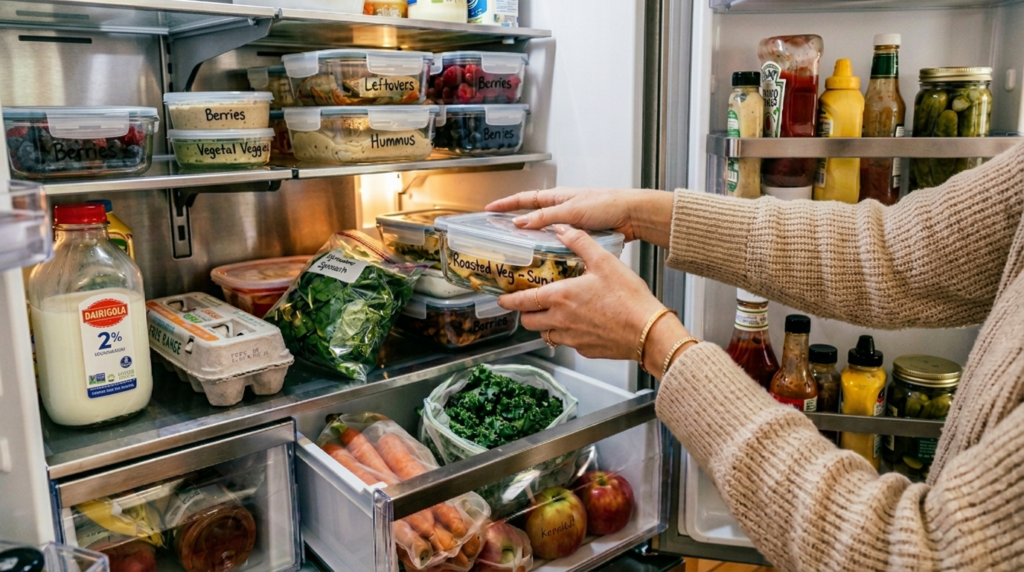
Every Sunday morning, before I plan anything, I force myself to open the fridge and the pantry and take a real inventory of what’s in there. It sounds so boring that I almost crossed it out, but it is the single most useful thing I do all week. I pull everything out. I check expiration dates. I put whatever needs to be eaten soon right in the front where I can’t ignore it. Half a box of pasta, some ancient frozen peas, a lime that’s starting to turn hard, two cans of diced tomatoes (I swear they reproduce on their own in the pantry, there are always more than I remember buying).
I type it all into my phone notes. Just a chaotic list, nothing pretty. Then I try to build the first few meals of the week around whatever needs saving. Frozen peas and pasta? That’s Monday’s dinner with some butter, parmesan, and whatever meat we have around. The lime gets squeezed into something, anything, just so it doesn’t turn into a small green rock.
This is exactly how I stopped rebuying stuff we already had. I once found four cans of coconut milk in the back of the cabinet. Four. I don’t even cook that many things with coconut milk. I guess past-me just kept seeing it on sale and grabbing it, like a squirrel hiding nuts it’ll never find again.
What We Actually Spend on Groceries

For years, I avoided looking at our actual grocery spending. Years. Because I knew I wouldn’t like the number. But eventually, I saved two weeks’ worth of receipts, sat down at the table after my son went to sleep, and added it all up. It came out to something like $210 a week. For two adults, one kid, and our cat Athena, who needs a proper introduction. Athena is a fluffy madam with royal tendencies who always acts like she’s dying of starvation, even though the vet says she’s in perfect shape. Also, she steals bread off the table. Not deli meat, not fish. Bread. Especially the heels that nobody else wants. She’s a weirdo, but we love her.
Anyway, $210 felt like overkill. So I set a rough target: $130 to $160 a week. That covers breakfasts, lunches, dinners, school snacks for my son, and Athena’s cat food (she exclusively eats Grandorf, which runs about 40 bucks a month because of course my cat demands premium imported European food). Some weeks I keep it under $140 and feel like a financial genius. Other weeks I blow past $170 because I don’t know, the salmon looked too good.
And I always leave a mental cushion of 15 or 20 bucks for unplanned stuff. Because my son will one hundred percent want pizza on a Friday. Or on Wednesday I’ll be so exhausted that just the thought of cooking will make me want to lie facedown on the kitchen floor.
What a Real Week Looks Like at Our House
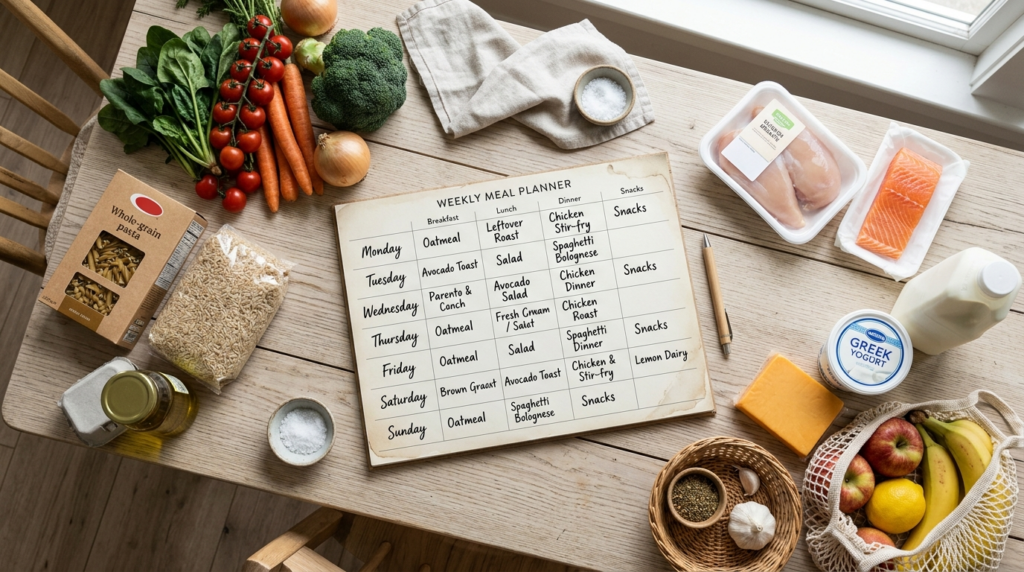
I want to be honest: meal plans on the internet look like they’re put together by people who wake up at 5 AM and do yoga before whipping up a three-course breakfast. Our week does not look like that. Our week looks like a person trying their best at the stove, a kid who hates boiled carrots with an intensity I didn’t know existed, and a cat who will knock your water glass off the table if you ignore her for too long.
Mornings are survival mode. Monday is oatmeal because it requires zero brainpower. Tuesday is eggs and toast. Wednesday I toss whatever fruit we have into a blender with yogurt and a handful of frozen spinach (my son has no idea it’s in there, and I plan on taking that secret to my grave). Saturday is pancake morning. It’s a whole production because my son insists on flipping them himself. Flour flies everywhere, Athena sits on the counter watching with intense interest. It takes three times longer than it should, but it’s the best part of the week.
My son’s lunches are a whole separate negotiation. He eats pasta with butter (no tomato sauce, he decided it’s “spicy,” which it isn’t, but we don’t argue about it here). He’ll eat carrots, but only raw. He would literally rather starve than eat a boiled carrot.
Dinners are where the planning really saves me. Monday is roast chicken with potatoes. That chicken carcass then works for me the rest of the week: I pick off the leftover meat, and it goes into other meals. Tuesday is turkey chili, which I intentionally make way too much of because it freezes beautifully. Thursday is what I call “eat what’s left” night. Sometimes that means a decent vegetable stew. Sometimes it means pasta with leftover cheese and a sliced-up hot dog because I was exhausted and my son was absolutely thrilled about the hot dog. I count that as a win.
When the Plan Falls Apart (And Why That’s Completely Fine)
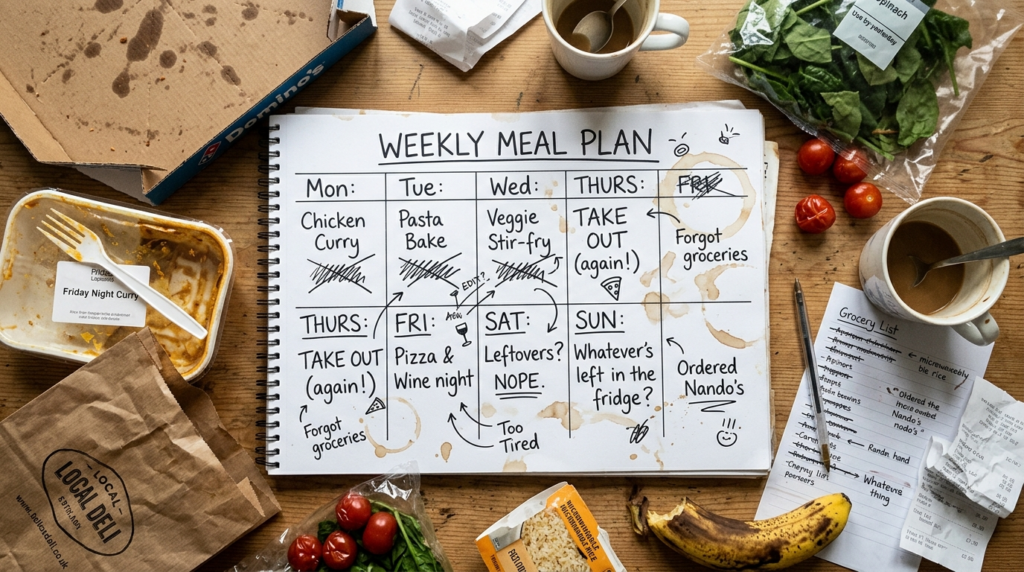
I want to be clear about one thing. The plan is not a blood oath. It’s just a suggestion you made to yourself on Sunday morning when you were full of optimism and caffeine. On Wednesday, you are a different person. You’re tired, your son is having a meltdown over homework, Athena just knocked a mug onto the floor, and you truly, genuinely do not want to cook that salmon. So you swap it with Friday’s pasta. Or you order a pizza, eat it on the couch, and start fresh tomorrow.
That’s not a failure. That’s just being human.
The plan exists so that on the days you do have the energy to cook, you know exactly what to make, and you have the groceries for it. So that you’re not throwing out $30 worth of food every week. Sure, there are weeks when everything goes off the rails. But over time, grocery trips stopped being pure torture. The fridge stopped being a cabinet of mysteries. And at the end of the month, there’s a little more money left in the bank account that doesn’t go toward expired yogurt or a third pack of mozzarella. It’s a small change, I know. But for us, it’s been genuinely huge. I think even Athena is happier, though honestly, that might just be because I started buying better bread.