

Okay so if you’re here, your cheesecake probably cracked and you’re either mad or panicking or both. Been there. Been there so many times I lost count somewhere around cheesecake number fifteen, when my husband walked into the kitchen, looked at the counter covered in failed experiments, and said “are we opening a bakery or are you having a breakdown?” Fair question honestly.
Why Do Cheesecakes Crack? My Thanksgiving Disaster That Started an Obsession
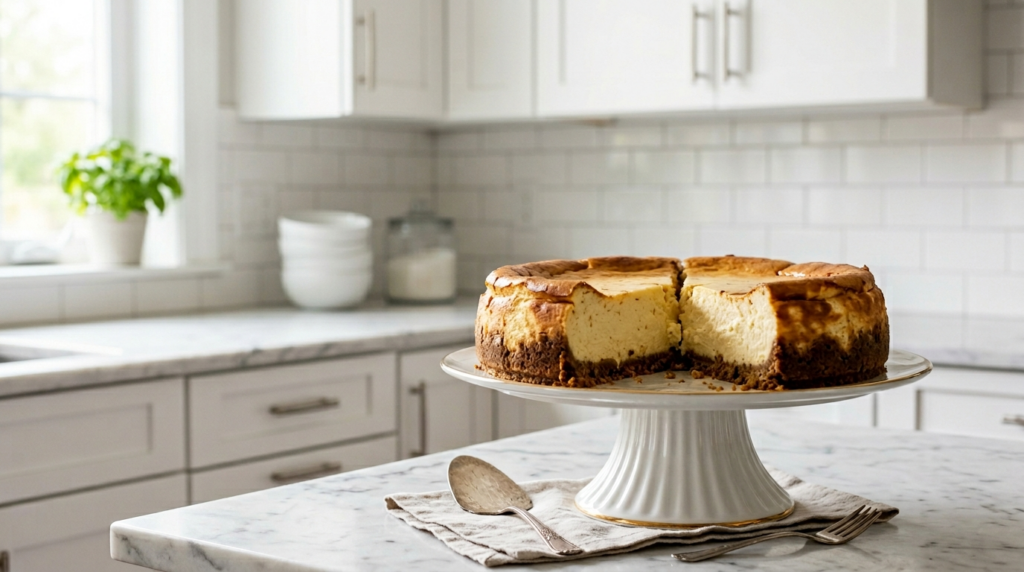
Few years back I made a cheesecake for Thanksgiving. It was beautiful coming out of the oven. Like genuinely magazine-worthy. I left it on the counter to cool, went to take a shower because I had guests coming and I smelled like butter and vanilla and not in a cute way. Came back twenty-something minutes later and there was a crack down the middle so deep I could see the crust through it. I just stood there staring at it in my bathrobe with wet hair dripping on the floor. My daughter walked in, looked at it, looked at me, and said “so… are we doing store-bought?” We were not doing store-bought. I smeared strawberry jam over the whole thing and nobody at dinner said a word, but I knew. I KNEW.
That was the night I started obsessively researching why cheesecakes crack. And I mean obsessively. My husband found me at midnight reading a food science paper about egg protein denaturation and asked if I was okay. I was not okay. I was going to figure this out.
So I spent the next couple months baking cheesecakes basically every weekend. My son, who was little then, thought it was the greatest thing that had ever happened to him. Cheesecake for breakfast? Sure buddy. Cheesecake after school? Why not. He didn’t care if they were cracked or sunken or ugly. He just wanted his slice with extra strawberries. My husband was less thrilled because the dishwasher was running twice a day and our electric bill went up from me running the oven nonstop, but he survived.
So Why Does It Actually Crack
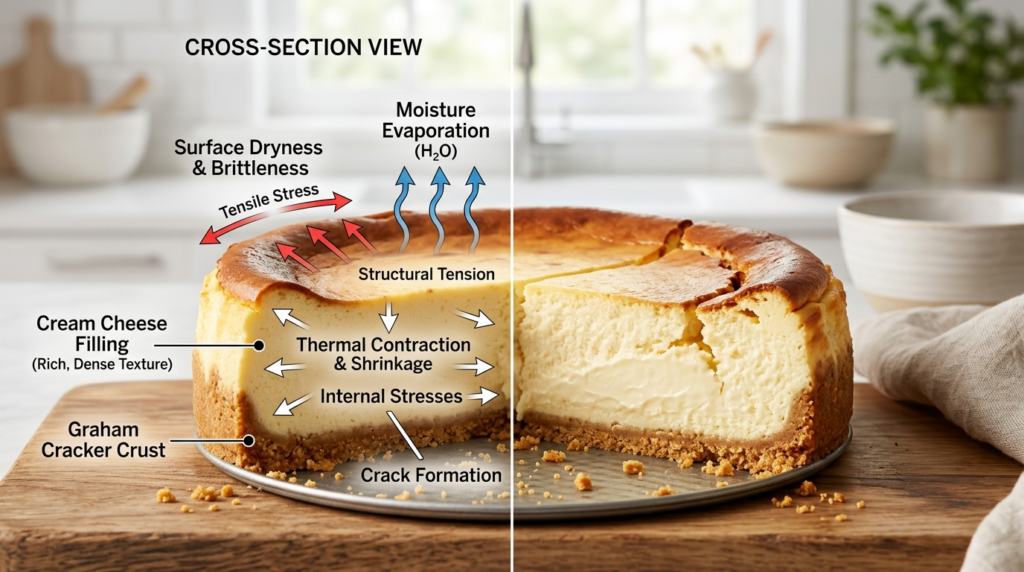
I’m not a food scientist. I don’t have a chemistry degree. But after reading way too many articles and ruining way too many cheesecakes, the basic idea is this: cheesecake is not a cake. It’s a custard. It’s eggs and cream cheese and dairy all hanging out together, held in shape by egg proteins that are, frankly, drama queens. When you heat them too much or beat them too hard, they freak out and contract. They squeeze out moisture. And the top of the cheesecake, which already set and went firm, can’t stretch to accommodate the shrinking underneath, so it just tears open. That’s your crack. That’s it. Everything that causes cracking comes back to this: something happened too fast or too aggressively and the eggs got upset about it.
Now the specific things that trigger it.
Overbaking is the big one and it’s obnoxious because it’s hard to tell. An overbaked cheesecake can still look wobbly and underdone when you peek at it. What you actually want to see when you gently tap the side of the pan is a little circle in the center, maybe two inches across, that jiggles like Jell-O. Not liquid, not sloshing around, just a soft wobble. I spent ages trying to eyeball this and getting it wrong until I finally bought a cheap instant-read thermometer and just started temping the center. 150°F. Pull it. Done. Before the thermometer I was guessing, and my guesses were consistently terrible.
Oh and recipe bake times? Basically fiction. “55 to 70 minutes” is a fifteen-minute window for a custard that can go from perfect to overcooked in the space of like three minutes at the end. My old oven ran hot and I didn’t figure that out for an embarrassingly long time. Just kept blaming the recipes. Start checking early and trust your eyes and thermometer over whatever the recipe says.
Cooling too fast. This one got me for years YEARS. I’d pull the cheesecake out and put it on the counter because that’s what you do with hot things, right? No. Apparently no. The shock of going from a hot oven to room temperature is too much for the custard. What you actually need to do is turn the oven off, crack the door open about an inch, I use a wooden spoon, and let the cheesecake sit in there for a full hour. Then counter for another hour. Then fridge. And this is the part where I lose my mind a little because the cheesecake is sitting RIGHT THERE and it smells incredible and you cannot touch it for basically six hours. My son always asks “is it ready yet” about forty times during this process. No buddy. It’s not ready yet. Go play Minecraft.
Overbeating the batter. Sneaky. You’re mixing the cream cheese and it’s lumpy and you think oh I’ll just mix it a bit more and then you’ve accidentally whipped a bunch of air in. That air puffs up in the oven, the cheesecake rises, and when it cools it deflates and the top rips open. Keep your mixer on low. The whole time. I know it’s tempting to crank it. Don’t. Eggs get like fifteen seconds each, just until the yolk vanishes into the batter. My husband once “helped” by turning the mixer up to 6 while I was answering the phone. That cheesecake looked like the surface of the moon.
Cheesecake Ingredients Guide: Cream Cheese, Sour Cream, Eggs Substitutions
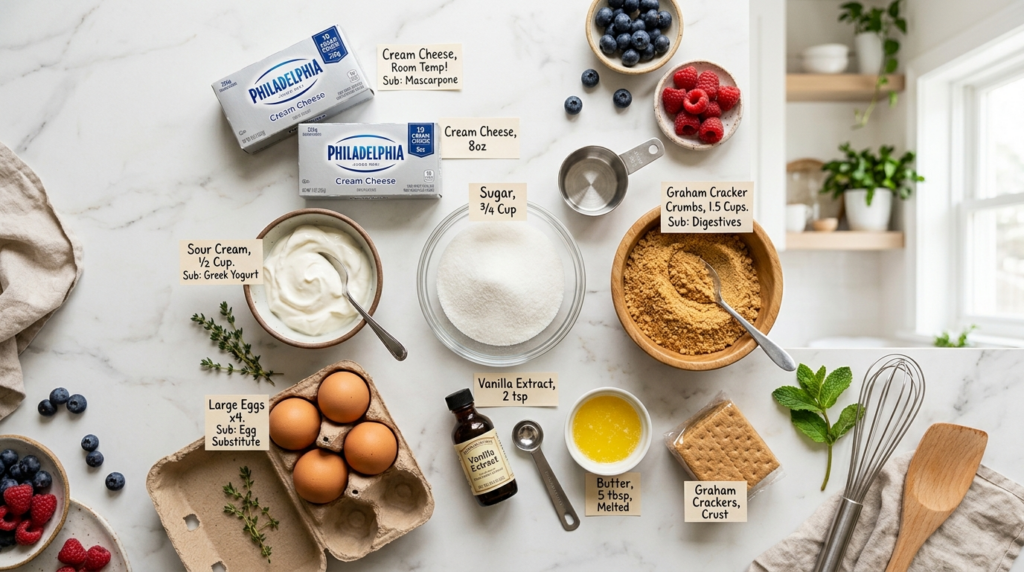
I tried low-fat cream cheese one time because it was all they had at the store and I didn’t feel like driving to another one. Grainy. Watery. Cracked horribly. Never again. Full-fat Philadelphia in the brick, not the tub. The tub is whipped, different moisture content, different result. Is it more expensive now than it used to be? Yes. Is finding it sometimes weirdly difficult depending on which store I go to? Also yes. But this is the hill I will die on.
Room temperature. Please. I’m begging. Cold cream cheese doesn’t blend smooth, so you end up beating it longer trying to get the lumps out, which whips in air, which causes cracking. I pull it out two hours before I start. Sometimes I forget and the blocks are sitting on the counter and my cat is sniffing them and I’m shooing her away while trying to remember if I also took the eggs out. The eggs also need to be room temp. Same reason. Cold eggs plus warm batter equals lumps equals overmixing equals cracks equals me eating my feelings at 10 PM.
For the rest of the filling I use about a cup of sour cream and a third cup of heavy cream. I’ve tried a million ratios. This is just what I like. More sour cream makes it tangier, more heavy cream makes it richer. Play around. Or don’t. Just use what I said and save yourself the trouble.
Quick detour on substitutions because I know someone’s going to ask. Greek yogurt works fine instead of sour cream, full-fat, plain. Whole milk can sub for heavy cream, not quite as lush but totally fine. Vanilla bean paste instead of extract is actually better, those little black specks are so pretty in the finished cheesecake and I’m a sucker for that kind of thing. What you absolutely cannot swap out is the eggs. I’ve seen eggless cheesecake recipes online and I’m sure they’re fine for what they are but they’re a different dessert entirely. The eggs are doing all the structural work here.
How to Make the Perfect Cheesecake: My Tested Step-by-Step Recipe
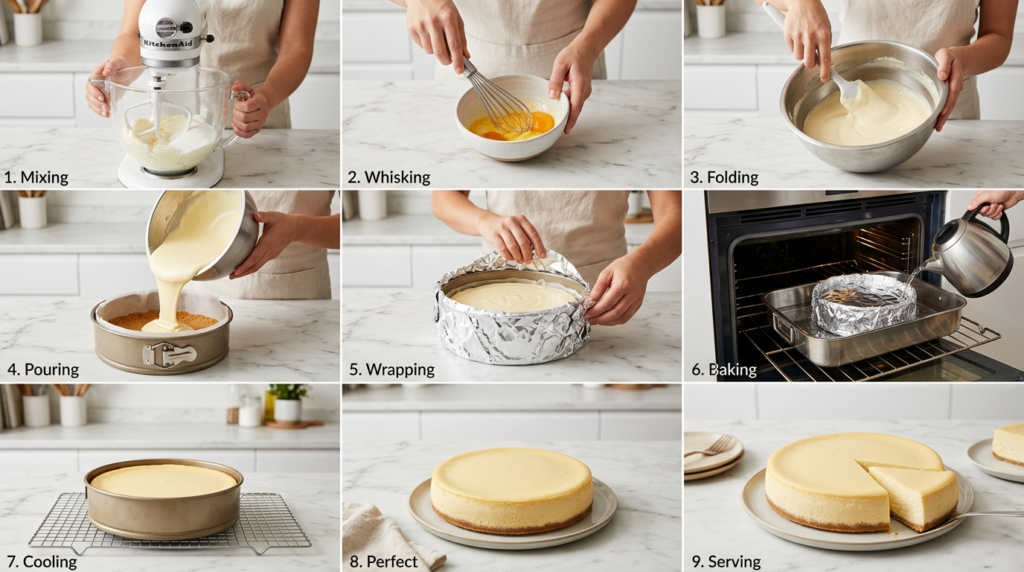
Crust first because I like to get the easy part done. Cup and a half of graham cracker crumbs, quarter cup sugar, five tablespoons melted butter. Press it into the springform, push it up the sides about an inch. Ten minutes at 325°F. Let it cool completely. I usually make the crust while scrolling my phone with one hand which is why my phone screen is perpetually greasy and my husband keeps asking why the phone smells like butter. Because I’m multitasking, that’s why.
The water bath. Ugh.
I have such a complicated relationship with water baths. For years I’d wrap the springform in foil and lower it into a roasting pan of hot water and then hover around the oven convinced that water was seeping in through some invisible tear in the foil to ruin my crust. Which happened. Twice. The second time I said some things I won’t repeat here because my kids read this blog sometimes. The fix, and I genuinely don’t know why it took me so long to figure this out: put your springform inside a regular cake pan that’s a bit bigger. Pour the hot water into the outer pan. Springform never touches water. No foil. No leaking. No swearing. Boil a full kettle before you start the filling so the water’s ready when you need it.
Filling. Four blocks of cream cheese, low speed, two minutes, scraping the bowl down all the time. ALL the time. Every thirty seconds, stop and scrape. It’s boring and your arm gets tired and there’s cream cheese splattered up the side of the mixer that you’ll be cleaning for the next twenty minutes, but if you don’t do it you get lumps. A cup of sugar, another minute. Three tablespoons of flour, and yes I know some people think flour in cheesecake is a crime, but it gives you a little wiggle room on the bake time and I genuinely cannot taste the difference. I did a blind test. My daughter couldn’t tell either. My son just ate both slices and asked for a third.
Sour cream, heavy cream, mix barely. Eggs one at a time, four large plus one extra yolk. That extra yolk is a trick from an old cookbook and I really do think it makes the texture creamier. Two teaspoons vanilla and a pinch of salt. The batter at this stage smells so good it’s physically difficult not to eat it with a spoon. I may or may not lick the spatula every single time. Pour it in the crust, tap the pan on the counter a few times, into the water bath, oven at 325°F.
55 to 65 minutes but START CHECKING AT 50. Look for the wobble. Then oven off, door propped, walk away, go watch a show, do not stand there staring at it. One hour in the oven. One hour counter. Plastic wrap loosely on top. Fridge. Four hours minimum. Overnight is honestly better, day-two cheesecake has this denser silkier thing happening that fresh cheesecake just doesn’t have.
How to Fix a Cracked Cheesecake: 3 Easy Tricks That Hide It Completely
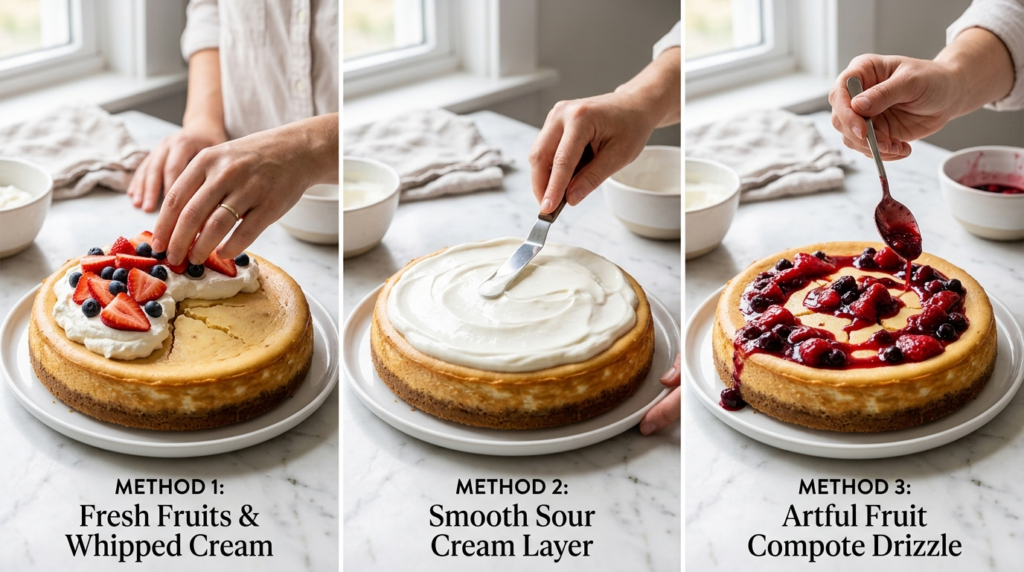
Okay so maybe you found this article after the damage was done. No judgment. Here are your options and I have personally used every single one of them.
Sour cream topping. Cup and a half of sour cream, three tablespoons sugar, teaspoon of vanilla. Spread it over the top while the cheesecake is still warm, back in the oven at 300°F for eight minutes. It sets into this gorgeous smooth white layer that completely covers the evidence. This is what bakeries do by the way. That pretty white layer on deli cheesecakes? It’s not decoration. It’s damage control.
Ganache if you want to go the chocolate route. Half cup heavy cream, heat till it bubbles, pour over chopped dark chocolate, wait, stir till glossy. Pour it over the chilled cheesecake, fridge for thirty minutes. Nobody will ever know. And honestly? Chocolate-topped cheesecake might be better than what you originally had in mind.
Or just throw fruit on it. Berries, whipped cream, caramel, whatever’s in the fridge. I’ve served cracked cheesecakes at dinner parties and literally not one person has commented. People just want dessert. My son especially does not care what it looks like. He once ate a slice that had basically collapsed in on itself and said it was “the best one yet.” Kids are great for your ego sometimes.
How to Store and Freeze Cheesecake So It Still Tastes Perfect
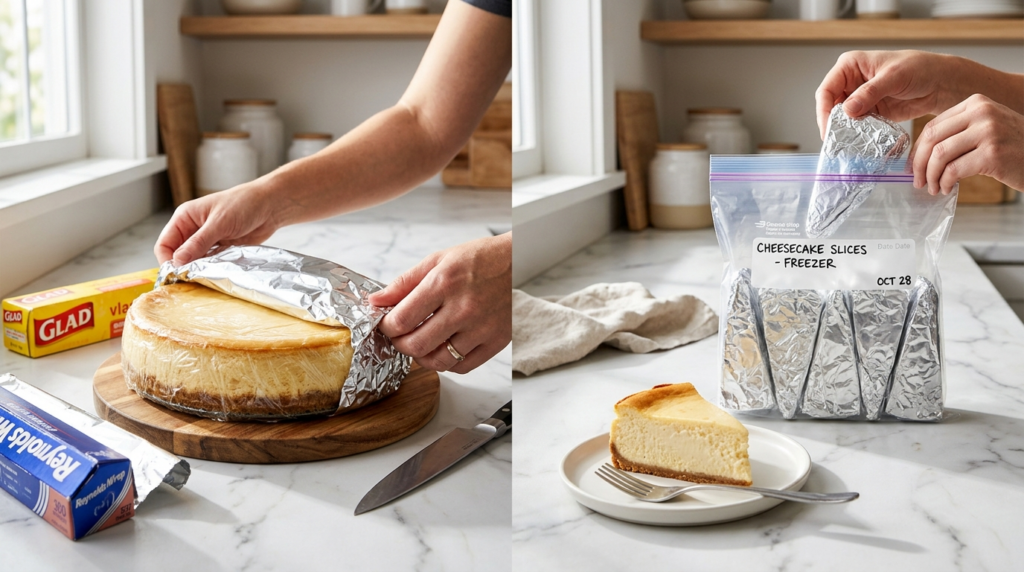
It’s cream cheese and eggs and sugar and butter. It’s not a health food. Let’s just acknowledge that and move on.
Keeps about five days in the fridge wrapped up tight. Like I said, make it ahead, it’s better on day two anyway. Freezing works, wrap slices individually in plastic then foil then a freezer bag. Good for a couple months. Thaw in the fridge overnight, do NOT microwave it, you’ll get this horrible hot-outside-frozen-inside situation that’s just deeply unpleasant. And don’t reheat cheesecake period. Pull a slice out fifteen minutes before you eat it and let it warm up just slightly on the counter. That’s the spot where it cuts clean but tastes creamy instead of like a cold brick.
Alright. That’s everything I know about cheesecake cracks. Go make one. And if it cracks, just put fruit on it and pour yourself a glass of wine. It’s still cheesecake. It’s still delicious.