

Alright, here’s how it actually went down. The first time I tried living on a $50-a-week grocery budget, I came home with three bags of chips, some overpriced blue cheese I don’t even like (why did I buy that? still a mystery), and absolutely zero plan for dinner. I stood in my kitchen. The fridge stared at me. I stared back. Neither of us had answers. That was three years ago. Now I spend the same fifty bucks without breaking a sweat, and here’s the funny part: I eat better than when I was blowing $200 a week like a total amateur.
Meal Planning on $50 a Week: It’s Not a Starvation Diet
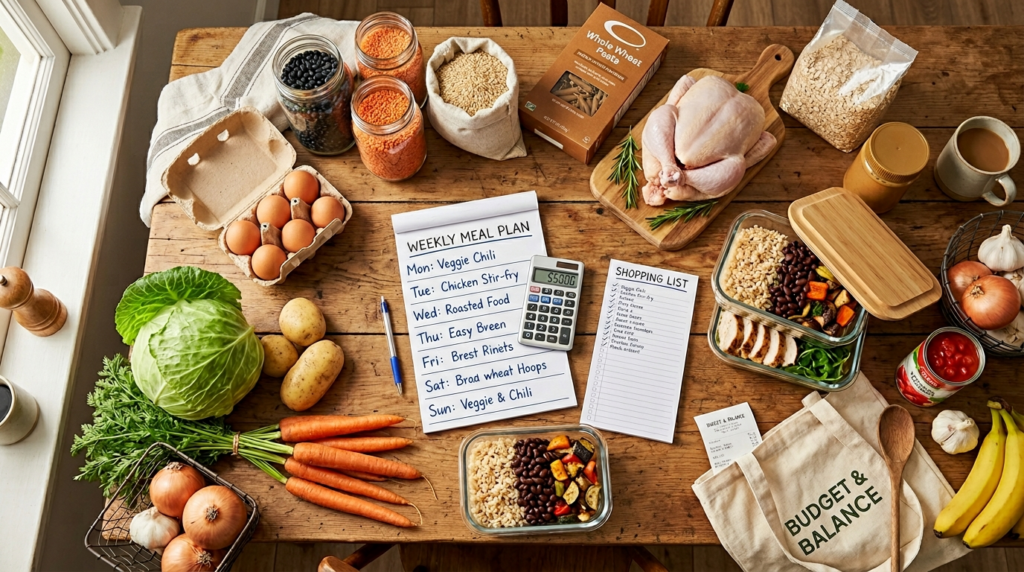
When people hear “$50 a week,” they immediately picture sad instant noodles and tap water. I know. I thought the same thing. But here’s the deal: the average American drops somewhere between $150 and $300 a week on groceries. And where does half of it go? Into the thing that quietly rots on the back shelf of your fridge. Into frozen dinners nobody actually wanted. Into those “accidental” checkout-line purchases that somehow leap into your cart. I once impulse-bought a fondue set that way. I live alone. Why do I need a fondue set?
Do the math. Fifty bucks is roughly $7 a day. Three meals at about $2.30 each. For one person, totally doable. For a family of four, multiply it, that’s $200. And cooking for a bigger family actually ends up cheaper because you buy in bulk and stretch everything further.
The trick isn’t about denying yourself stuff. The trick is thinking before you walk into the store. Instead of standing in the aisle wondering what to grab. Sounds boring? Maybe. But it works embarrassingly well.
What You Actually Need in a Budget Kitchen (and What’s Just Junk)
I’m not gonna tell you to buy a bunch of fancy kitchen gadgets to “save money.” That’s like buying a gym membership to “save on medical bills.” The logic tracks, but in practice? Not so much. There are, however, a couple of things I genuinely wish I’d bought sooner.
The Slow Cooker: My Go-To Tool for Cheap Dinners
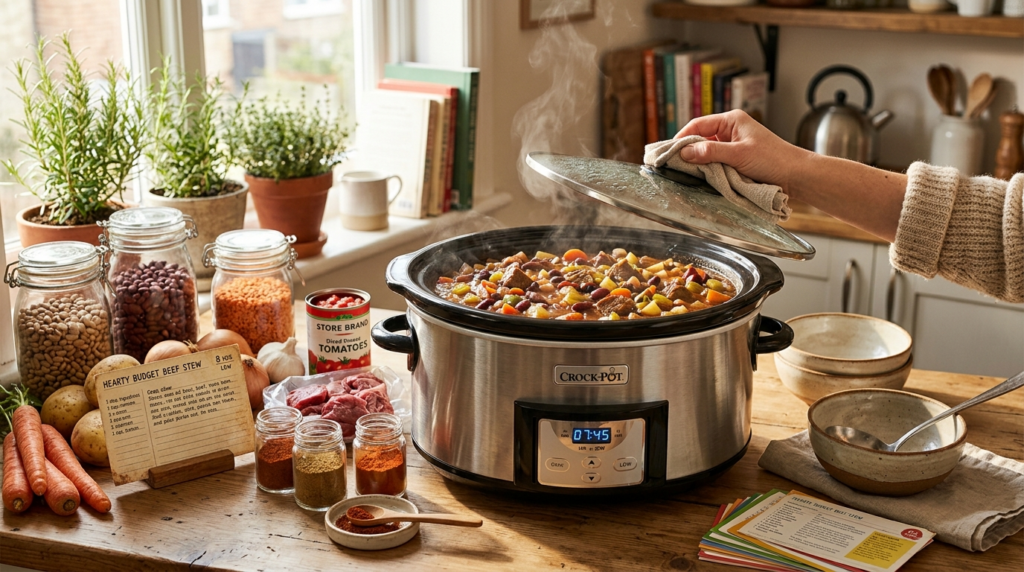
The slow cooker. Seriously, this thing is the MVP of my kitchen. In the morning I toss in some cheap chicken thighs, head out the door, come back and dinner’s done. Over two years, it’s probably saved me hundreds in takeout alone. I treat it like a member of the family. Sometimes I talk to it. Don’t judge me.
Also, a sharp knife. A dull knife slows everything down and creates more waste. And decent storage containers. Without those, the whole “cook ahead” system just collapses.
Oh, and almost forgot: skip the food steamer. Mine collected dust for exactly one month before migrating to the back of the cabinet. Permanently. Just because a gadget is “healthy” doesn’t mean it’s useful to you.
How to Stock a Pantry From Scratch Without Going Broke
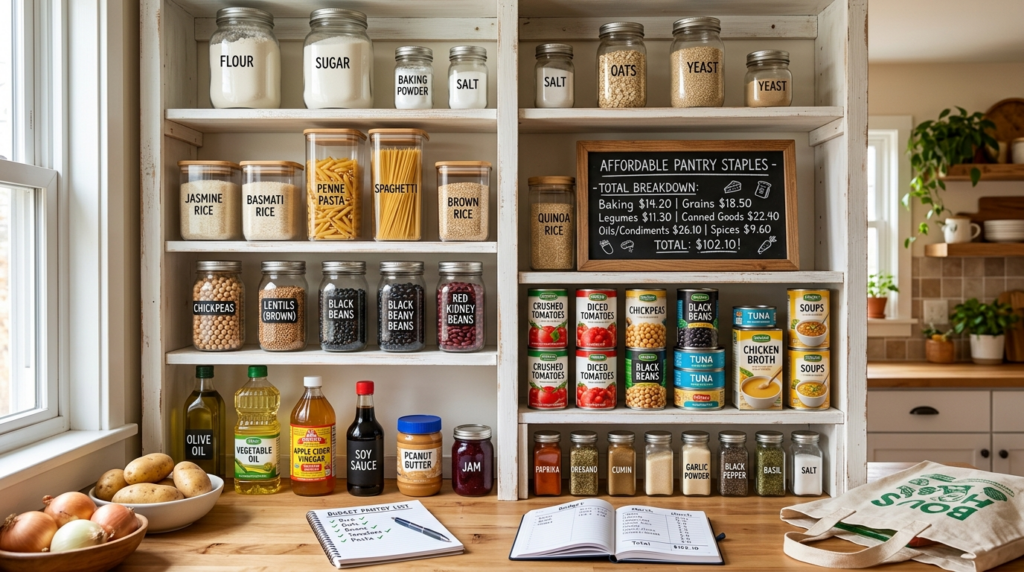
Build your pantry slowly. I tried doing it all at once, spent $200, got frustrated, and almost quit the whole thing. Just add a few items each week. In a month you’ll have a solid foundation.
For grains, I always keep a big bag of white rice. I grab a 10-pound bag at the Asian market for about eight bucks, and it lasts months. Pasta in two or three shapes, flour, oats. And definitely potatoes, a few pounds at least. People seriously underestimate potatoes. They’re filling, you can make pretty much anything out of them, and they last for weeks if you store them right. Potatoes are the silent hero of the budget kitchen.
For protein, this is where it gets interesting. Dried beans cost next to nothing. Black beans, pinto, chickpeas, pick your favorite. Lentils are even better because you don’t need to soak them and they cook fast. Peanut butter. Canned tuna. And eggs. Eggs are probably the single most useful thing in any kitchen. Period.
And the most important thing people forget about: spices. Salt, pepper, garlic powder, onion powder, cumin, chili powder, Italian seasoning. Soy sauce and hot sauce are permanent residents of my fridge door. And a jar of Better Than Bouillon. It costs a little more upfront but lasts months and turns plain water into real broth. All these little things cost almost nothing per meal, but they’re exactly what makes “cheap” food taste good. Without spices, budget food is punishment. With spices, it’s cooking.
How I Actually Grocery Shop on $50 a Week
Best Stores to Save Serious Money on Groceries
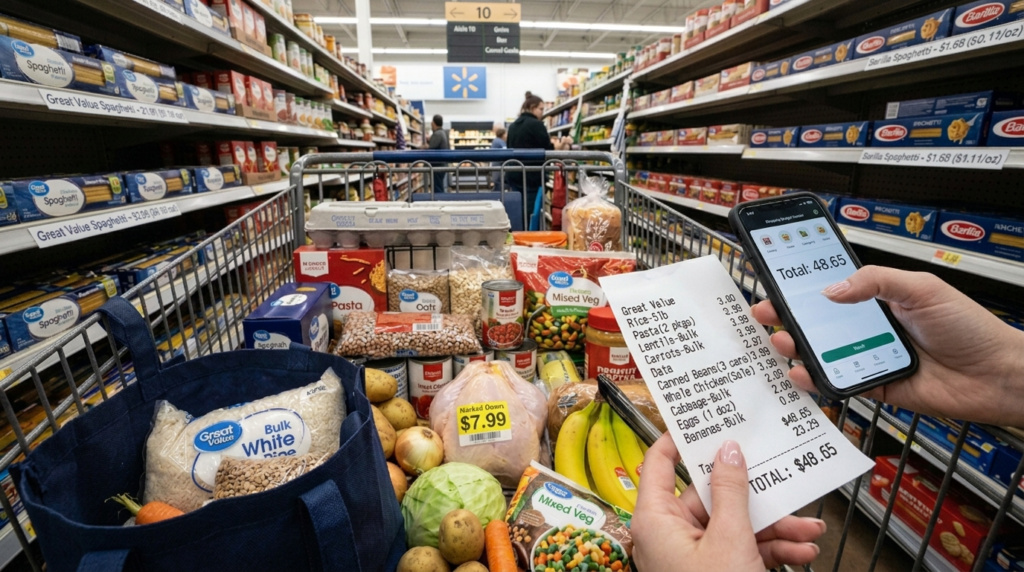
I do most of my shopping at Aldi. I’ll be straight with you, the produce there can be hit or miss, kind of a lottery. But the staples are consistently cheap and decent quality. For spices and rice, I drive ten minutes to this little Mexican grocery store near my place. Their bulk spice section is a completely different universe compared to what I used to pay at the big chains. Honestly, I’m a little embarrassed it took me two years to find that spot. The amount of money I overpaid for cumin in cute little jars… I’d rather not think about it.
Ethnic grocery stores in general are a goldmine. Rice, beans, spices, fresh vegetables, everything runs about 30 to 50 percent cheaper than the big-name supermarkets. It’s not some insider secret. People just don’t go there out of habit. Their loss.
How I Split Up My $50 Grocery Budget
I don’t have some crazy spreadsheet. Roughly it goes like this: protein (chicken, eggs, beans, ground beef if it’s on sale) takes about $15 to $18. Produce gets $12 to $15. Grains and bread, $8 to $10. Dairy, $6 to $8. Whatever’s left goes to canned goods, spices, or a little two-dollar treat. Sometimes that’s a chocolate bar. I’m a human being, not a monk on a mountain.
Quick sidebar. One time I went two straight weeks without buying myself anything “extra,” and by the end of week two I was standing in the store staring at a $1 package of cookies with the face of a man who just found his lost wallet. Bought them. Ate them. No regrets. Small joys are part of the budget too, they just don’t show up in spreadsheets.
My Saturday Morning Grocery Run

I usually roll into Aldi on Saturday around 8 AM. Before the crowds, before the sleepy parents with strollers, before the chaos. Because that’s when the meat department puts out those yellow “30 to 50 percent off” stickers. I hunt those things down with a seriousness that would make a Navy SEAL proud. Meat that’s nearing its sell-by date is perfect for cooking that same day or tossing straight in the freezer. Totally normal practice, nothing sketchy about it.
Never shop hungry. Everybody says it. Nobody listens. I once walked into a Whole Foods on an empty stomach on a random Tuesday and walked out having spent $47 on… crackers? Some ridiculously expensive seed crackers that apparently came with hopes and dreams baked in. I still have no idea what happened. Eat something before you go. Write a list. Stick to the list. If you spot something tempting, put it on next week’s list. Nine times out of ten you’ll completely forget about it by then.
Apps like Ibotta or Checkout 51 are worth five minutes of your time. I’m not a coupon fanatic, that’s a slippery slope to madness and cabinets stuffed with a thousand bottles of shampoo. But scanning a receipt to get cash back on stuff I was already buying? Easy money. Some months I get $15 to $20 back just from that.
A Simple Weekly Meal Plan That Won’t Stress You Out or Break the Bank
Here’s the thing nobody says out loud: you don’t need a perfect, color-coded plan with tabs and charts. You need “anchor meals.” A handful of reliable, cheap recipes you actually enjoy eating. The variety builds itself around those, naturally.
How I Put Together My Weekly Menu
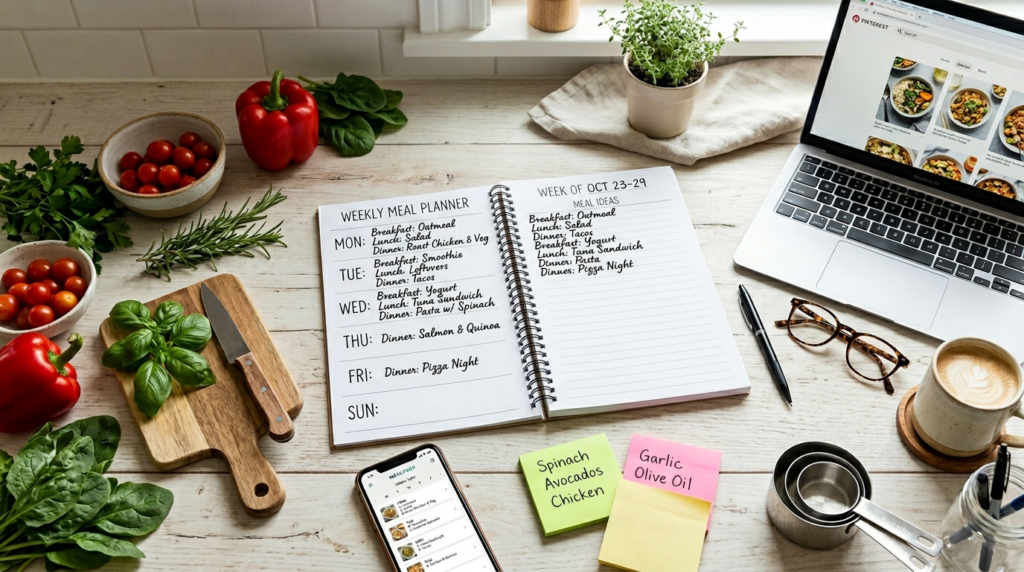
First thing I do is check what meat was on sale and build two or three dinners around it. Then I throw in a couple of vegetarian days. Beans and eggs have become my best friends, which is something I never would’ve believed three years ago. Me? Voluntarily? Eating beans? Ha. There’s always one “pasta night” because it’s fast, cheap, and everybody loves it. And one evening is “Leftover Transformation Night.” It used to be called “Random Fridge Scraps Night,” but I did a rebrand. Sounds classier. Same exact result.
Breakfasts rotate between oatmeal, eggs in various forms, and toast with whatever’s lurking in the fridge. Lunch is almost always yesterday’s leftovers or a sandwich. That’s it. No culinary theatrics happening here.
Cost-wise it breaks down like this: breakfast runs 50 cents to a dollar, lunch is a buck fifty to two fifty, dinner for four is $6 to $10 total, so roughly a buck fifty to two fifty per person. Snacks, maybe 25 to 50 cents. Full day per person comes to $7 to $14. Usually closer to seven.
How to Get Enough Protein Without Blowing Your Budget on Meat
Protein used to be my biggest headache. I grew up in a house where dinner meant a giant slab of meat in the center of the plate and everything else was decoration. Breaking that habit was rough. But the moment I did, the budget finally clicked. Like some switch flipped in my brain.
The Cheapest Protein Sources Per Serving
Dried beans are a cheat code. A bag costs a dollar, one serving runs about 15 cents, and the protein is nearly on par with chicken. Lentils, same deal, but they cook faster. Two eggs, 33 to 50 cents. Chicken thighs on sale, 40 to 60 cents a serving. Two tablespoons of peanut butter, 20 cents and 8 grams of protein. And a whole chicken at 99 cents a pound gives you 6 to 8 servings at 12 to 25 cents each.
Compare that to a steak. I’m not saying steak is banned. Just not every day. And only when there’s a massive sale.
One Chicken, Five Dinners: How I Actually Do It
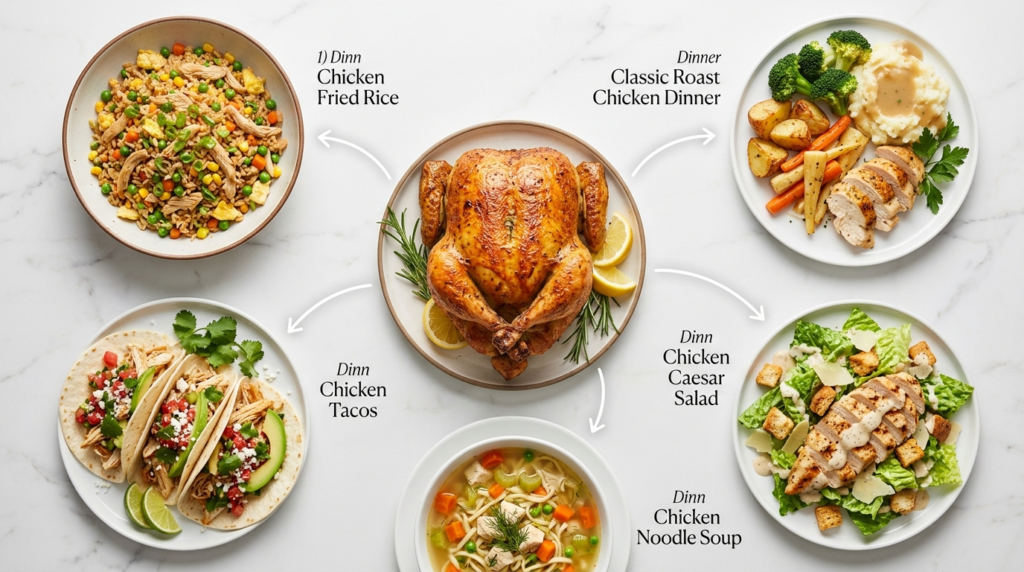
This changed my life. Not exaggerating. A whole chicken costs five or six bucks, and if you play it smart, it covers almost the entire week.
Sunday I roast it with potatoes and carrots, there’s dinner. Monday I pull the breast meat off and make a stir-fry. Tuesday I pick whatever’s left clinging to the bones and turn it into chicken salad for sandwiches. Wednesday I boil the carcass, now I’ve got broth for a soup with all those vegetables that need to be used up before they turn sad. Oh, and almost forgot: Thursday there’s usually a few scraps still hanging around, so hello, fried rice. Five dinners. One six-dollar bird.
The first time I tried this, I burned the chicken. Got sucked into my phone, oven was cranked too high, and I ended up with expensive charcoal. I stood there looking at that charred corpse thinking, “Great start to the new life.” I set a timer now. Every single time.
How to Buy Vegetables Cheap: Seasonal Shopping and Frozen Hacks
Buy What’s in Season and Your Wallet Will Thank You
Spring brings spinach, lettuce, and the first strawberries. Summer is all zucchini, tomatoes, corn, melons. Fall means apples, pumpkin, sweet potatoes, and cabbage. Winter: citrus, root vegetables, and more cabbage. Cabbage is like that friend who’s always free, reliable and cheap. Year-round I grab bananas, carrots, potatoes, and onions. They’re inexpensive regardless of the season and go into everything.
Frozen Veggies Aren’t a Compromise, They’re a Strategy
I used to feel a little weird putting bags of frozen broccoli in my cart. Like it was some kind of admission of culinary defeat. “Look at this loser buying frozen vegetables.” Then I learned that vegetables are usually flash-frozen at peak ripeness, while the “fresh” ones at the supermarket might’ve been sitting in trucks and warehouses for days. Nutritionally, frozen often wins. And they’re a dollar a bag on sale.
My freezer always has a mixed veggie blend, spinach, peas, corn, and broccoli. They go into stir-fries, soups, pasta, fried rice. Zero waste. Nothing rots. Just food that’s always there, waiting for its moment.
Batch Cooking: How I Save Time and Money in a Couple of Hours

I know, I know. Everyone talks about meal prep. I used to roll my eyes too. Then one Wednesday happened. Got home at 7 PM, completely drained. Fridge had nothing but a lonely cucumber and some broken dreams. Ordered Thai food for $25. A third of my weekly budget, gone in one tired evening. I sat there with my pad thai container thinking, “Okay, maybe those meal prep nerds are onto something.”
Now I spend two to three hours on Sunday. Not the whole day. Just a couple of hours with a podcast playing in the background.
First thing I do is get the protein going, usually chicken in the oven and ground meat on the stove at the same time, or I get a pot of beans started. While that’s cooking, I throw on a big batch of rice. Meanwhile, I chop everything I bought for the week: onions, peppers, carrots, the works. I make a soup or stew for lunches through Friday. If I’ve still got energy, I whip up egg muffins for breakfasts. And one more thing that makes life way easier: I pre-mix spices into little jars ahead of time. So on Thursday night I’m not digging through the pantry with a flashlight like some kind of cave explorer.
Two hours of work. Five days of not having to figure out dinner from scratch.
A Few Words on Storage
Glass containers for anything going in the microwave. Plastic for cold stuff and dry goods. Freezer bags laid flat, they take up barely any space. Glass jars for salads and overnight oats. Food looks pretty in jars, and somehow that keeps me motivated. Weird, but true. Your brain sees neat little jars and thinks, “This person has their life together.” Even when that’s not entirely accurate.
A Real $50 Weekly Meal Plan With an Actual Grocery List
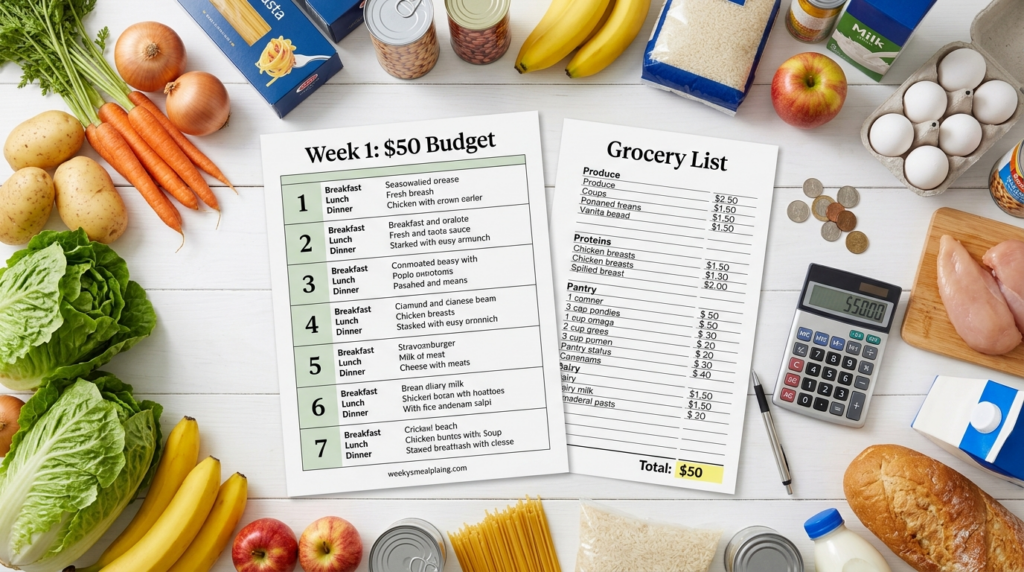
One Week for a Family of Four
This is a real week, not some textbook theory. Here’s what I bought: whole chicken ($6), two pounds of ground turkey ($6), 18 eggs ($3), gallon of milk ($3), block of cheese ($3), two loaves of bread ($2), rice ($2), pasta ($2), four cans of tomatoes ($3), dry black beans ($1.50), five-pound bag of potatoes ($3), onions ($2), carrots ($2), cabbage ($1.50), bananas ($1), apples ($3), two bags of frozen veggies ($2), peanut butter ($3), oats ($2). Grand total: exactly $50.
| Day | Breakfast | Lunch | Dinner |
| Sun | Scrambled eggs & toast | PB&J sandwiches | Roast chicken with potatoes |
| Mon | Oatmeal with banana | Chicken salad sandwich | Turkey pasta in red sauce |
| Tue | Fried eggs & toast | Leftover pasta | Black bean tacos |
| Wed | Oatmeal with apple | Rice & bean bowl | Chicken vegetable soup |
| Thu | Fried eggs | Leftover soup | Turkey fried rice |
| Fri | Oatmeal with banana | PB&J sandwiches | Pasta with veggies |
| Sat | Egg sandwich | Leftover fried rice | Black bean stew |
Budget Meal Planning When You Live Alone
Cooking for one is its own kind of quest. Everything comes in family-sized packs, and half of it goes bad before you can finish it. My secret is embarrassingly simple: freeze half of everything the day you buy it. Chicken, ground meat, even bread. It’s the only way to stop throwing food away. I used to forget this step and every Friday I’d sadly toss out a loaf of bread that had turned green. Now it’s autopilot.
Budget Recipes That Actually Taste Like Real Food
By the way, cheap food doesn’t have to look depressing. Drizzle some olive oil, toss on a pinch of herbs, and your chicken and rice looks like something off a cooking show. We eat with our eyes first. And a sizzling pan, a bubbling stew, those sounds turn the whole process from chore into something that almost feels like a treat. Almost. At least it doesn’t feel like punishment.
Breakfasts Under a Dollar
Overnight Oats (about 75 cents): Half a cup of oats, half a cup of milk, a spoonful of peanut butter, half a mashed banana. Stir it up in a jar at night, grab it in the morning. I’ve been making these for two years and I’m still not tired of them. Though honestly, maybe I’m just lazy and I like a breakfast that asks absolutely nothing of me in the morning.
Banana Pancakes (about 50 cents): One ripe banana, two eggs, a little flour. Mash, mix, fry like regular pancakes. My kid Kostya calls them “egg-bananas” and flat-out refuses to acknowledge they’re real pancakes. But he puts away four of them every time I make a batch, so his argument doesn’t hold up too well.
Lunches Under Two Bucks
Lentil Soup (about $1.50 per serving): Saute onion, carrots, and celery. Toss in dry lentils, a can of tomatoes, water or broth, spices. Simmer until it thickens up. Fun little detail: this soup tastes better on day three than day one. Seriously. One of those rare cases where leftovers beat the original.
Rice and Bean Bowl (about $1.75): Rice on the bottom, beans on top, sauteed veggies, a little cheese, hot sauce. Switch up the spices and you’ve got a Mexican bowl. Add soy sauce and sesame and suddenly it’s Asian. Same base, but your brain doesn’t notice. My brain definitely doesn’t notice. It’s a simple brain.
Dinners Under Three Bucks a Plate
One-Pot Chicken and Rice (about $2.25 per serving): Brown the chicken thighs, take them out. Saute onion and garlic in the same pan, dump in the rice, pour in broth, add frozen veggies. Put the chicken back on top. Cover and cook. Best part? One pan to wash. For me, that’s a stronger argument than any dollar amount.
Spaghetti Aglio e Olio (about $1.50): While your pasta boils, scoop out a cup of the cooking water. Slice garlic thin, saute it in olive oil, add red pepper flakes, toss in the pasta and splash in some of that starchy water. The starch mixes with the oil and makes a rich, silky sauce. Italians have been eating this for centuries, not because they were broke, but because it’s ridiculously good. First time I made it, I couldn’t believe something that costs a dollar fifty could taste like that. I kept looking around for the catch.
When Everything Falls Apart (Because It Will)
I want to be straight with you. Some weeks are hard. You get bored. You get wiped out. Life happens and the whole plan crumbles.
The number one cure for boredom? Sauces and spices. Rice and beans with cumin and lime is a completely different meal than rice and beans with soy sauce and garlic. I keep a whole “flavor arsenal” so I can dress up the same base ingredients in different world cuisines. Monday is Mexico. Wednesday is Asia. Friday is Italy. Same three dollars, but it feels like traveling. Well, almost. If you squint hard enough.
What Three Years of Budget Eating Actually Taught Me
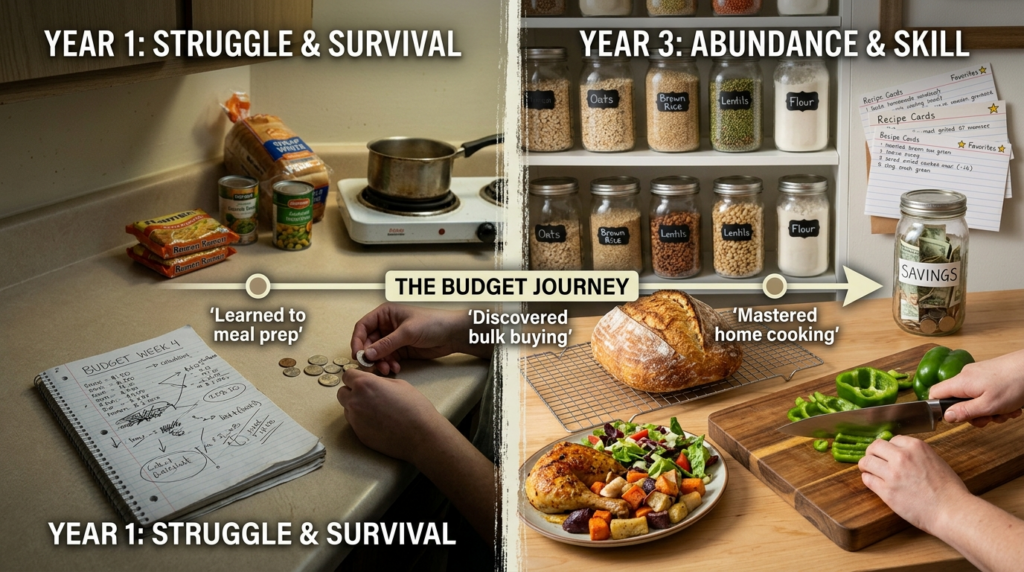
This system doesn’t work flawlessly every single week. Some nights I’m so wiped out we eat cereal for dinner, and I count that as a win because I didn’t hit the DoorDash button. The goal here isn’t perfection. The goal is to make planning a background habit, like doing laundry. You don’t think about it. You just do it.
If $50 feels impossible right now, start at $75 or $100. Build your base. And if you have a week where you order pizza twice, don’t beat yourself up over it. Just start fresh next Sunday. That extra hundred bucks sitting in your pocket at the end of the month is very real. I know because the first thing I spent my “saved” money on was that same dumb chocolate bar, except this time without a shred of guilt.