

A couple months back I tried to make that Basque burnt cheesecake that was all over TikTok. You know the one, scorched on top, creamy inside, looks like it went wrong but somehow that’s the point. The recipe was from a Spanish food blogger and everything was in grams. I didn’t feel like digging out my scale so I eyeballed the cup conversions. Got the cream cheese close enough, but the flour was way off. The thing didn’t just crack. It turned into something between a sweet omelet and a puddle. That night I finally sat down and learned how kitchen measurement conversions actually work. This guide is everything I figured out the hard way: ounces to cups, cups to grams, tablespoons to teaspoons, plus all the stuff that trips you up when you’re scaling recipes or switching between metric and imperial.
The Foundation: How Many Ounces in a Cup
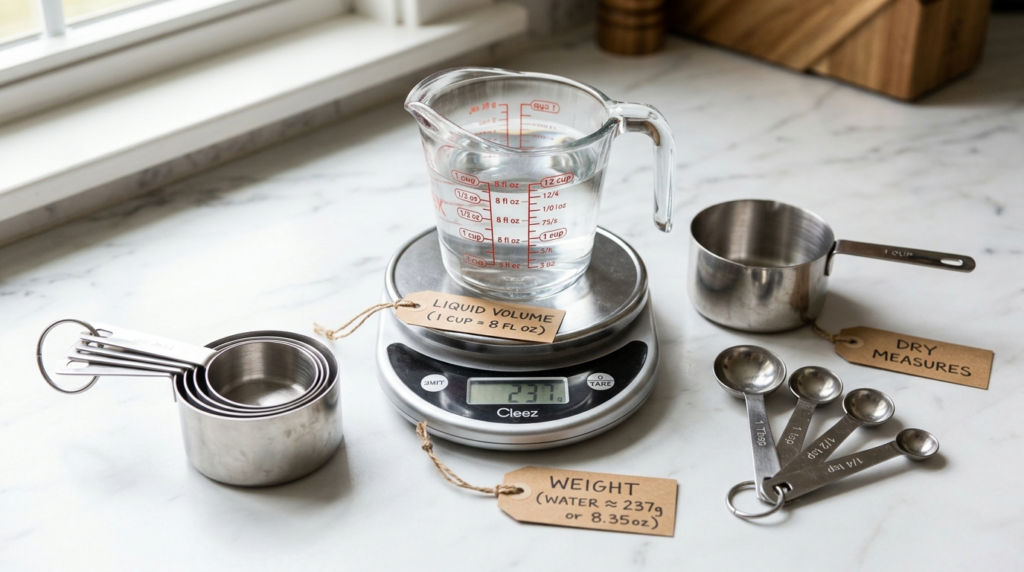
One US cup is 8 fluid ounces. For liquids, water, milk, broth, oil, that’s all you need. Pour it in, read the line, move on.
The trouble starts with dry ingredients. Weight ounces and fluid ounces are two completely different units of measurement that, for some cruel reason, share the same name. Fluid ounces measure volume, how much space something takes up. Weight ounces measure mass, how heavy it is. One cup of all-purpose flour weighs about 4.25 ounces. One cup of granulated sugar weighs about 7 ounces. Same cup. Wildly different weight.
Liquid conversions are the easy part. Half a cup is 4 fluid ounces. A quarter cup is 2 fluid ounces. A third of a cup comes out to roughly 2.67 fluid ounces. These numbers don’t change no matter what you pour into the cup, because fluid ounces measure volume and volume stays the same whether it’s water, cream, vegetable stock, or olive oil.
Most professional bakers don’t even use measuring cups for dry ingredients. They weigh everything. And it makes sense: if you scoop flour straight from the bag (and we all do it when we’re in a rush), the flour packs down and you end up with 20-30% more than the recipe writer meant. Your dough comes out stiff. Your bread is dense. And you’re sitting there going “but I followed the recipe.” For dry ingredients, there’s no universal cup-to-ounce formula. You need conversion tables for each specific ingredient.
Then there’s the international thing that nobody warns you about until it’s too late. A US cup is 236.588 milliliters. The metric cup used in Australia, Canada, and New Zealand is an even 250 milliliters. The old British imperial cup is 284.131 milliliters, though most British cooks have gone metric by now. Japan uses a 200-milliliter cup. I made a meat pie once using a recipe from RecipeTin Eats (Nagi Lawson’s site, if you haven’t seen it, she’s incredible). The pastry came out too wet and I spent a solid twenty minutes annoyed at myself before it hit me: the Australian cup is 14 milliliters bigger than the American one, and across several cups of flour that gap added up fast. Now the first thing I check on any recipe from the internet is what country it came from.
How Many Tablespoons in a Cup: Breaking Down Smaller Measurements
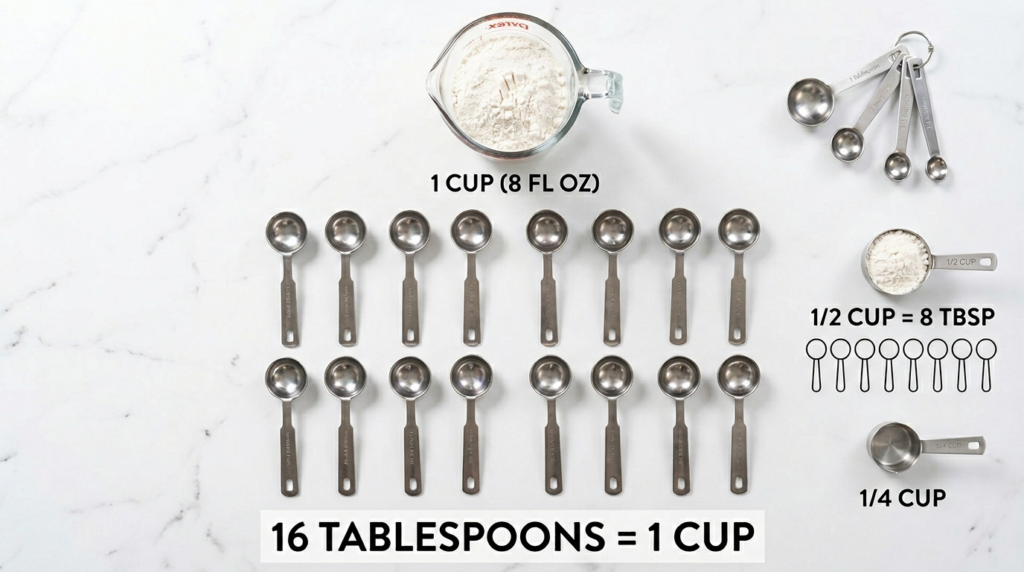
One cup is 16 tablespoons. Remember that number.
I use this conversion more than any other, usually on weeknights when every measuring cup I own is dirty and all I can find is a tablespoon. Half a cup is 8 tablespoons. Quarter cup, 4. Eighth, 2. After enough dinners you stop doing the math and just grab the spoon and count.
US Tablespoon and Cup Conversion Chart
| US Cup | Tablespoons (Tbsp) | Teaspoons (Tsp) |
| 1 Cup | 16 | 48 |
| 1/2 Cup | 8 | 24 |
| 1/3 Cup | 5 Tbsp + 1 Tsp | 16 |
| 1/4 Cup | 4 | 12 |
| 1/8 Cup | 2 | 6 |
| 1 Tablespoon | 1 | 3 |
Each tablespoon holds 3 teaspoons. A full cup is 48 teaspoons, a number you’ll probably never use in real life, but it fills in the picture. What actually comes in handy is converting weird amounts. Recipe calls for 5 tablespoons of something? That’s 1/4 cup plus 1 tablespoon. Way easier to measure than hunting around for some imaginary 5/16-cup scoop that no one manufactures.
Here’s something that bit me once and I never forgot it: tablespoon sizes are not the same around the world. The US tablespoon is 14.787 milliliters. The metric tablespoon is a flat 15 milliliters. Close enough for most things. But in Australia, a tablespoon is 20 milliliters. That’s four teaspoons instead of three. I was making a chicken marinade from an episode of MasterChef Australia and the soy sauce tasted flat. Not bad, just… underwhelming. Took me a while to realize I was short on every single tablespoon measurement in the recipe because my American spoons were smaller than what the recipe assumed. For a stew or a braise that probably wouldn’t matter. For a marinade where every milliliter of soy sauce and fish sauce counts, you notice.
This tablespoon-to-cup math becomes a lifesaver when you’re cutting a recipe in half and the fractions get ugly. I needed half of 3/4 cup olive oil for a pesto the other week. Half of 3/4 is 3/8 of a cup. Good luck finding that marking on your measuring cup. I just counted out 6 tablespoons and got on with it.
How Many Cups in a Quart: Scaling Up Your Measurements
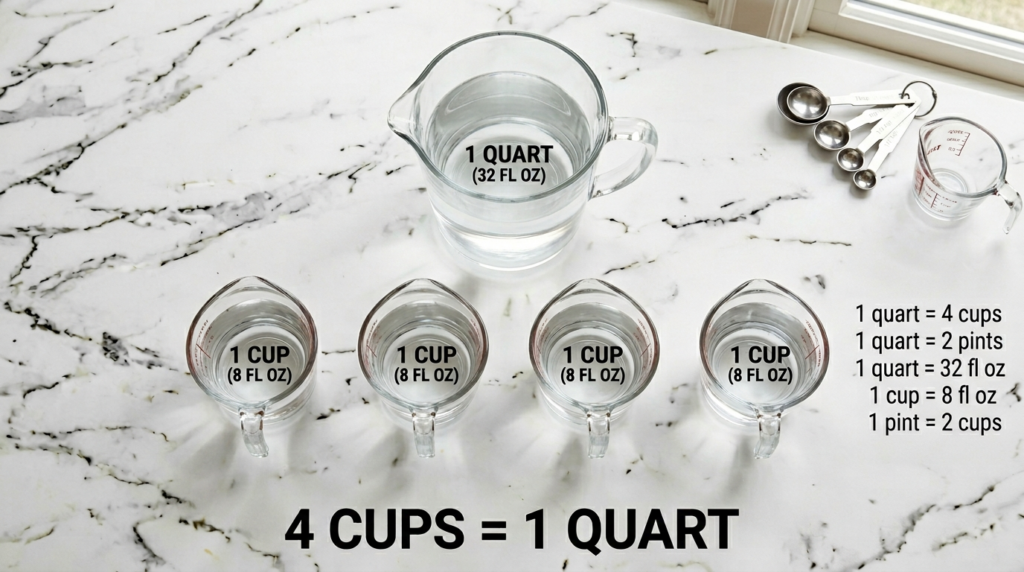
Four cups in a quart. Two cups in a pint. Two pints in a quart. Four quarts in a gallon. The whole thing doubles at each step. A gallon is 16 cups.
Volume Conversion Chart: Cups, Pints, Quarts, and Gallons
| Unit | Quarts (Qt) | Pints (Pt) | Cups (Cups) |
| 1 Gallon (Gal) | 4 | 8 | 16 |
| 1 Quart (Qt) | 1 | 2 | 4 |
| 1 Pint (Pt) | 0.5 | 1 | 2 |
| 1 Cup (Cup) | 0.25 | 0.5 | 1 |
Last Thanksgiving I was tripling a gravy recipe for twelve people. The original called for 6 cups of chicken stock, so one and a half quarts per batch. Three batches meant four and a half quarts. I was standing in the store staring at the shelf of boxed broth doing that math: each carton is a quart, I need five to be safe. Without knowing the cup-to-quart conversion I’d have either overbought or, worse, had to make a second trip to the store in the middle of cooking. With a house full of relatives. On Thanksgiving. No thanks.
You run into quarts at the grocery store all the time. Milk, broth, juice, they all come in quart cartons. If a recipe needs 3 cups of milk and you grabbed a quart, that leaves you exactly one cup for cereal tomorrow. A small thing, but when you’re cooking multiple dishes and trying to keep track of what’s left of what, these quick calculations save real time.
For metric users: one US quart is about 946 milliliters, just under a liter. The imperial quart, which still shows up in older British cookbooks (I ran into it in a Nigella Lawson beef stew recipe once), is 1.136 liters. That’s roughly 20% more liquid. Use American quarts on a British recipe without adjusting and you’ll end up noticeably short. For a home dinner you might not care. For a pan sauce that’s supposed to reduce by half, it changes the whole thing.
How Many Teaspoons in a Tablespoon: Mastering the Smallest Measurements
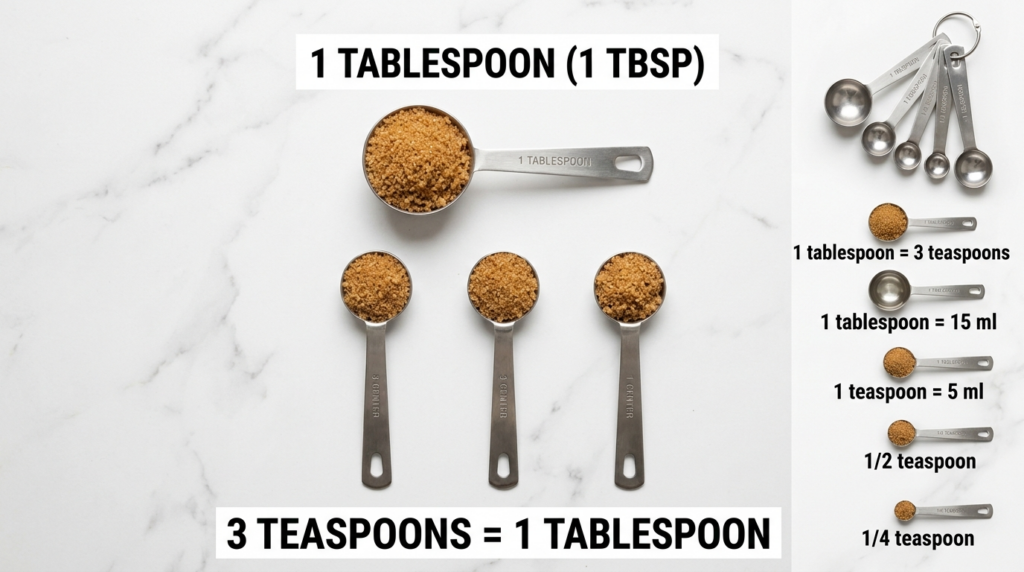
Three teaspoons in a tablespoon. That’s it.
Simplest conversion in this whole article, but also the one that saves you most often, because spices, leaveners, and extracts are the ingredients where small mistakes lead to the biggest problems. Half a tablespoon is one and a half teaspoons. Two-thirds of a tablespoon is two teaspoons. These awkward in-between amounts come up more than you’d think, especially with cinnamon, vanilla extract, and baking soda.
But there’s something I’ve never seen in a standard conversion guide that matters way more than people realize: not all tablespoons of salt are equal, even if you’re using the exact same spoon. Fine table salt weighs about 18 grams per tablespoon. Diamond Crystal kosher salt? About 9 grams for the same tablespoon. Literally half. Morton kosher salt sits in between at around 15 grams. When a recipe just says “1 tablespoon salt” without telling you which kind, you’re rolling the dice. I oversalted a risotto stock for my whole family because the recipe author was using Diamond Crystal and I grabbed the Morton’s from the pantry. Not the end of the world, but the rice was noticeably too salty and I had to stretch it with extra broth and butter. Now if I see salt in a recipe without a brand or type specified, I start with less and taste as I go.
Teaspoon accuracy matters most in baking. Baking powder, baking soda, yeast, these aren’t seasoning-to-taste ingredients. An extra teaspoon of baking powder gives you a metallic taste and a weird texture. Too little and the whole thing is flat. The gap between 1 teaspoon and 1 tablespoon of salt is a triple dose, and that’s enough to wreck almost anything.
International differences at the teaspoon level are small: the US teaspoon is 4.929 milliliters, the metric one is a flat 5 milliliters, the old British imperial was about 5.919 milliliters (almost nobody uses that anymore). For a single teaspoon of vanilla, doesn’t matter. If a recipe calls for 6 teaspoons of baking powder, those fractions start stacking up.
Cups to Grams: Ingredient-Specific Conversions
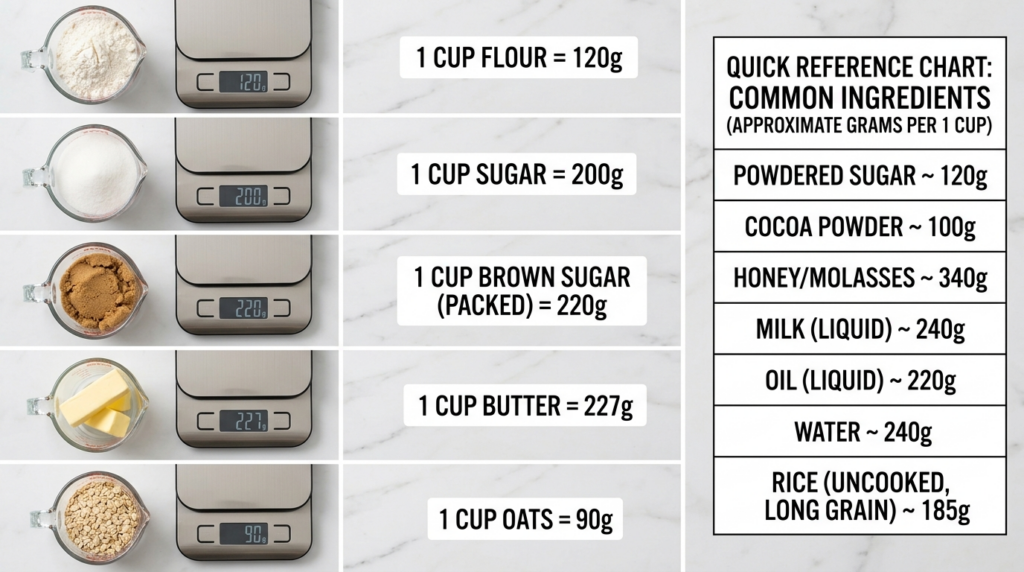
This is the part where most home cooks get lost. And I get it. Converting cups to grams is not one formula. It’s a different answer for every ingredient.
All-Purpose Flour is where the most arguments happen on cooking forums, and for good reason. One cup, measured the right way (spoon flour into the cup, level off the top with a knife), weighs 120 to 125 grams. Scoop it straight from the bag and you’ll pack it down to 140 or even 150 grams. That’s 20-30% more flour than the recipe intended, and it’s the single biggest reason home baked goods come out dry or too dense.
I resisted buying a kitchen scale for years. Figured it was one more gadget taking up counter space for no real reason. Then I got the cheapest digital scale I could find on Amazon, something like 11 bucks, and the first loaf of bread I baked with weighed flour turned out so much better than anything I’d made before that I was genuinely annoyed I’d waited so long. Been using it ever since, going on three years now. If you use King Arthur flour, their website lists one cup at 120 grams and all their recipes are built around that number. Good benchmark to keep in your head.
Granulated Sugar is denser because of the crystal structure. One cup weighs about 200 grams. Brown sugar is a whole separate issue: packed tight into the cup it’s around 220 grams, loose it’s about 145. When a recipe says “packed brown sugar” it means you press the sugar down into the cup until there’s no air left. I didn’t do this for the first year or so I was baking, and my oatmeal cookies always came out pale and not chewy enough. The fix was just packing the brown sugar harder. Powdered sugar looks like flour but only weighs about 120 grams per cup because the fine grinding traps air between particles.
Butter is the easy one. One cup equals two sticks equals 227 grams. Each stick is 113 grams, 8 tablespoons, half a cup. The wrapper on most American butter sticks has tablespoon markings right on it. Never had a conversion problem with butter, not once.
Liquids. A cup of water weighs 237 grams. Milk is a little heavier at 245 grams. Oil is lighter, about 224 grams. Nothing complicated there. Honey, though, is 340 grams per cup, and corn syrup is 328. Those numbers surprised me. Whenever I need honey for a recipe now I just weigh it straight into the mixing bowl, because scraping honey out of a measuring cup is a test of patience I consistently fail.
Nuts and Dried Fruits are all over the place, and mistakes here cost real money since nuts aren’t cheap. Whole almonds are about 140 grams per cup. Sliced almonds? Only 85 grams. Same cup, almost half the weight, because the slices leave air gaps everywhere. Chopped walnuts average 120 grams, pecans about 99, raisins pack tight at 165. If a recipe says “1 cup almonds” without specifying whole, sliced, or slivered, you’re guessing. Weigh them if you can.
Chocolate. Regular chips are about 170 grams per cup. Mini chips pack a little tighter at 180. Cocoa powder is deceptively light, just 85 grams per cup because of all the trapped air.
And here’s a distinction that tripped me up multiple times before I caught on: “1 cup melted chocolate” and “1 cup chocolate chips, melted” are not the same amount. The first means you melt the chocolate first, then measure a cup of liquid chocolate. The second means you fill a cup with chips and then melt them. I messed up a brownie glaze from a Sally’s Baking Addiction recipe because of exactly this wording. The glaze was way too thick and I couldn’t figure out why. Now I weigh chocolate before I melt it, every time.
Practical Applications and Pro Tips
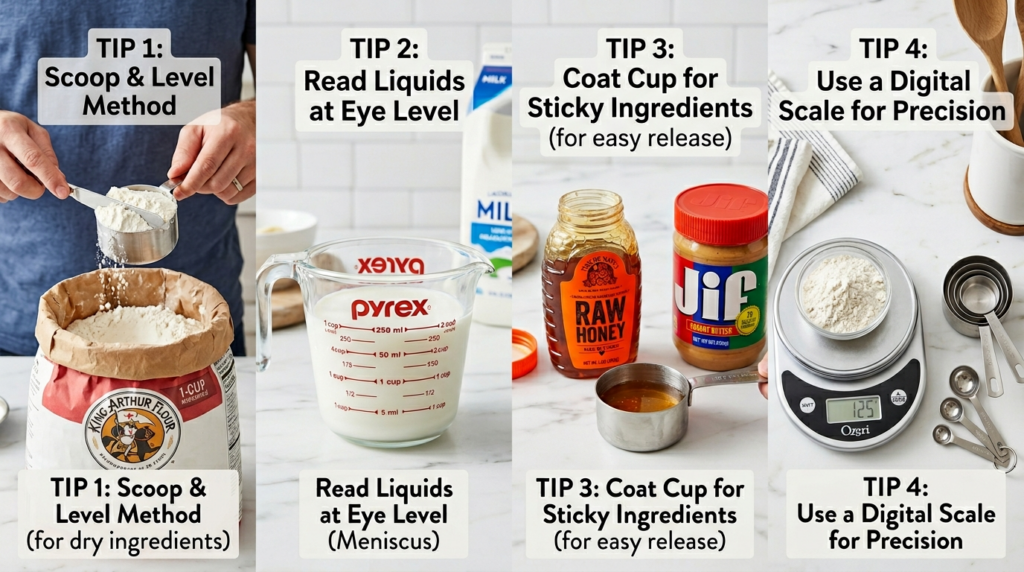
All of these numbers are useless if you can’t get to them fast when you need them. I have a printout taped to the inside of my kitchen cabinet door with the conversions I use most: flour, sugar, butter, cocoa powder. Doesn’t look pretty. But when my hands are covered in dough and my phone is buried under a dish towel, I just open the cabinet and look. It’s been there two years and honestly it’s one of the best things I’ve done for my cooking.
If you’re going to buy a scale, and I really think you should, you don’t need to spend a lot. Mine cost 11 dollars and still works fine. The OXO one for about 25 bucks is nice if you want something with a pull-out display so a big mixing bowl doesn’t cover the screen. But even the cheapest no-name digital scale off Amazon is more accurate than a measuring cup for dry ingredients. And there’s a bonus I didn’t expect: less dirty dishes. You put your bowl on the scale, hit tare, add flour, hit tare, add sugar, hit tare, add cocoa. One bowl instead of three cups and two spoons.
Temperature changes volume measurements for some ingredients. Cold butter takes up different space in a cup than softened butter does, even though they weigh the same. Coconut oil is the same way, solid versus melted gives you a different reading in a measuring cup. When precision counts, weigh it.
Check where your recipe comes from before you start cooking. Takes thirty seconds. American recipes use US customary measurements. British recipes can look similar but the cup and tablespoon sizes are different. Australian and European recipes are usually metric. Getting this wrong is the kind of quiet mistake where you follow a recipe “perfectly” and the food still comes out wrong and you can’t figure out why.
More and more cookbooks are listing both volume and weight now. I think in a few years most serious recipes will put grams first and cups second. Can’t come soon enough.
Conclusion
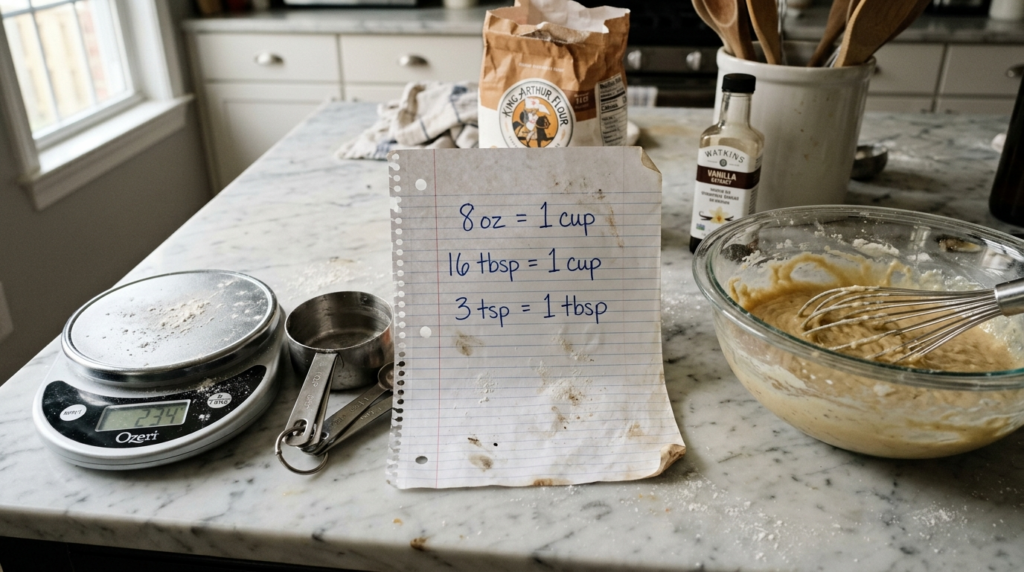
Eight ounces in a cup. Sixteen tablespoons. Four cups in a quart. Three teaspoons in a tablespoon. Individually, none of it is hard. The complicated part is that all of it connects, and the numbers shift depending on the ingredient, the measuring technique, and the country the recipe came from. But these conversions click faster than you’d expect, and once they do, new recipes stop feeling intimidating.
Regular cooking, stir fries and braises and soups, is forgiving. A little more oil, a little less garlic, an extra pinch of oregano, none of that is going to ruin dinner. Baking is different. Baking cares about every gram. The trick is knowing which situation you’re in.
Start with whatever conversions show up most in your own cooking. For me it was tablespoons to cups and flour weight in grams. Those two fixed most of my problems. Stick a cheat sheet inside your cabinet. Get a scale, even a cheap one. And when something doesn’t turn out, don’t sweat it too hard. Everybody messes up. I still mess up. The difference between now and a year ago is that when something goes wrong, I can usually figure out why, and I know how to fix it for next time. That’s worth more than any recipe.