

I spent an embarrassing number of years just grabbing whichever white powder was closer to my hand when a recipe called for one or the other. Baking soda vs. baking powder, they both make things rise, so what’s the difference, really? Then one Thanksgiving I made a pumpkin bread that tasted like I’d dissolved a bar of soap into the batter. My brother-in-law wouldn’t stop making jokes about it for literally three years after. That was the moment I finally sat down and figured out what baking soda and baking powder actually do, when to use each one, and why it matters way more than I ever thought it did.
Baking Soda: The Reactive One

Baking soda is sodium bicarbonate. One ingredient, nothing else mixed in, just a pure alkaline compound sitting in your cabinet waiting for acid. And by acid I mean buttermilk, yogurt, lemon juice, vinegar, natural cocoa powder, honey, brown sugar, even molasses. When those two meet in your batter, carbon dioxide starts forming, little bubbles get trapped in the wet mixture, and when the heat from the oven sets the protein structure around those bubbles, that’s your rise.
The thing is, the reaction kicks off the second wet hits dry. Not “in a few minutes.” Right then, while you’re still scraping the bowl. I learned this trying to make blueberry pancakes for a crowd. I mixed everything up, then wandered off to find the blueberries in the back of the fridge, realized I was out, had to defrost frozen ones in the microwave, tried to drain the extra liquid with a paper towel that immediately fell apart… by the time I actually poured the batter onto the griddle it was basically flat. Dense. Like sad little crepes but without any of the elegance.
And here’s a detail nobody warns you about until you learn it the hard way: baking soda is roughly four times as strong as baking powder. So if you accidentally dump in a tablespoon instead of a teaspoon, you don’t just get extra lift. You get this metallic bitterness that coats the roof of your mouth and kind of makes your tongue feel like sandpaper. If you’ve ever bitten into a muffin and had that weird dry, penny-licking sensation, that’s too much baking soda. And no amount of cream cheese frosting covers it up. Believe me, I tried.
Baking Powder Is More of a DIY Kit
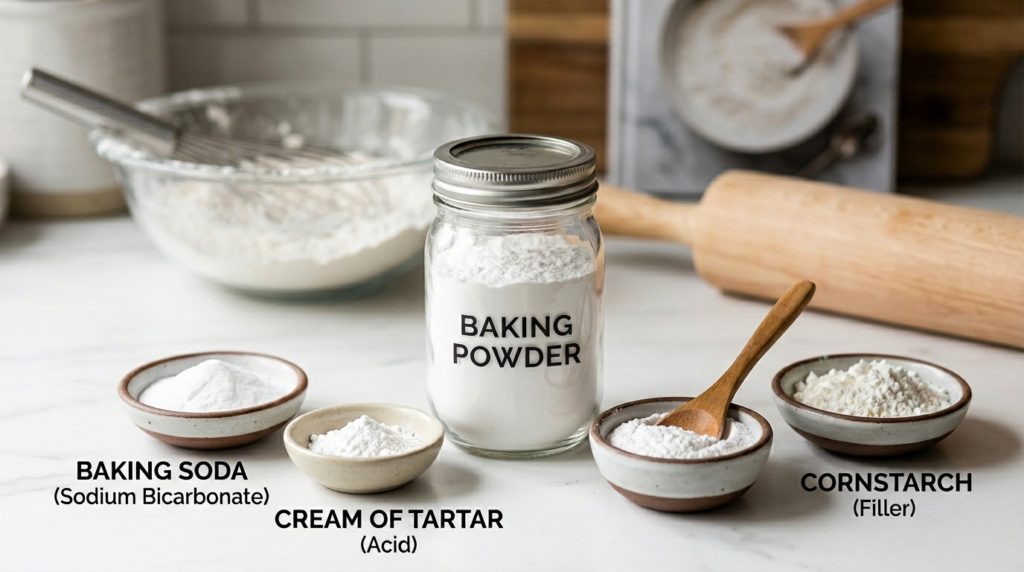
Baking powder is basically baking soda with its own acid already packed inside, usually cream of tartar or sodium aluminum sulfate, plus a little cornstarch as a buffer so the whole thing doesn’t go off in the container while it’s sitting on the shelf. It doesn’t need your batter to be acidic. It’s got everything it needs already.
Most of what you’ll find at the store is double-acting, meaning it reacts twice: once when it gets wet at room temperature, then again when the oven heat kicks in and activates the second acid. So you get two separate shots at making your cake puff up. This is honestly why baking powder is so forgiving for home bakers, even if you’re slow getting the pan into the oven (and I am always slow), that second reaction picks up the slack.
Single-acting baking powder exists too, but it’s mostly a professional bakery thing and I wouldn’t lose sleep over it.
Why Some Recipes Call for Both
This confused me for the longest time and I’ve seen the same question pop up on every baking forum I’ve ever scrolled through at 1 a.m.
The short version is that they do different jobs. Baking soda deals with the acid in your recipe, it neutralizes the buttermilk or the sour cream, produces some lift along the way, and shifts the pH enough to change browning and flavor. Then baking powder steps in for extra rise, because the soda alone might not create enough gas to get you where you need to be. They’re working as a team, not as stand-ins for each other. I used to think “well the recipe says both, but I only have soda, so I’ll just use more of it” and that… yeah. Don’t do that.
Color, Texture, Spread: The Stuff Nobody Mentions
Here’s where it gets kind of cool even if you’re not a baking nerd.
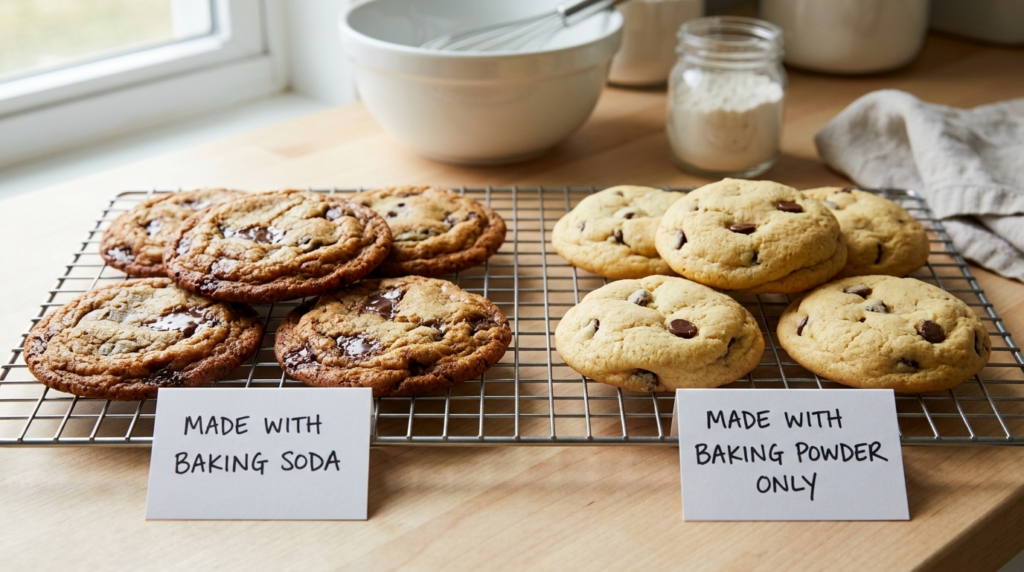
Baking soda makes things brown. And not just a little. It pushes the pH alkaline enough to really accelerate Maillard reactions, which is that gorgeous golden-to-deep-amber color on banana bread, on the edges of a good chocolate chip cookie, on soda bread crust. I did a side-by-side once, same cookie recipe, one batch with soda, one with powder. The soda cookies came out looking like a food blog photo, deep amber with caramelized edges and that slightly crackled top. The powder ones looked… fine. Pale, a little puffy, like they were trying their best but hadn’t quite committed.
Too much soda tips things the other direction real fast though. Suddenly you’ve got cookies that look almost burnt and taste like pennies. The sweet spot is genuinely narrow with this stuff.
Texture is the other big difference. Baking soda encourages cookies to spread out, so you end up with thinner, chewier results that get crispy at the edges. Baking powder pushes upward, giving you puffier, cakier cookies. The great cookie debate, chewy versus cakey, is honestly just a leavener argument wearing a disguise.
Is Your Baking Powder Even Still Alive?
I feel like this needs to be said bluntly because it’s probably the single most common reason people think they’re “just bad at baking.” That canister of baking powder that’s been sitting in the cabinet since you moved into this apartment? It’s done. It lost its potency months ago and at this point it’s basically expensive cornstarch.
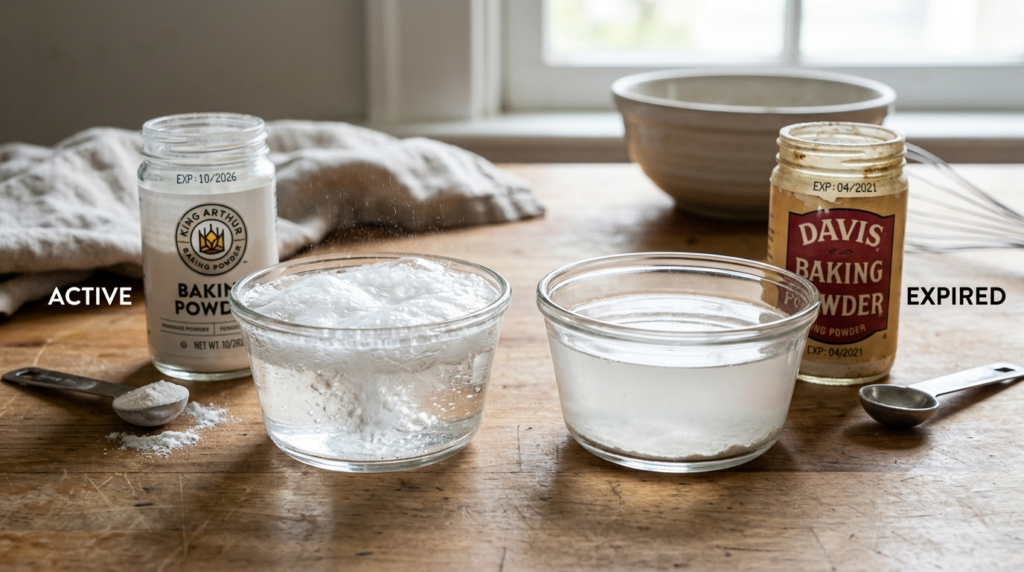
Baking soda keeps its strength longer, maybe two or three years if it’s sealed, around six months once you crack it open. Drop a spoonful into some vinegar and watch what happens. If it fizzes hard, like it’s mad at you, you’re good. If it kind of weakly bubbles and gives up… time to buy a new box. Baking powder is pickier. Six months after opening, maybe nine if you’re lucky, and that’s being generous. Stir a teaspoon into hot water. If it bubbles right away you’re fine. If it just dissolves and sits there doing nothing, toss it.
Write the date on the lid with a Sharpie the day you open it. Boring advice, but it actually works.
Swapping One for the Other When You’re Desperate
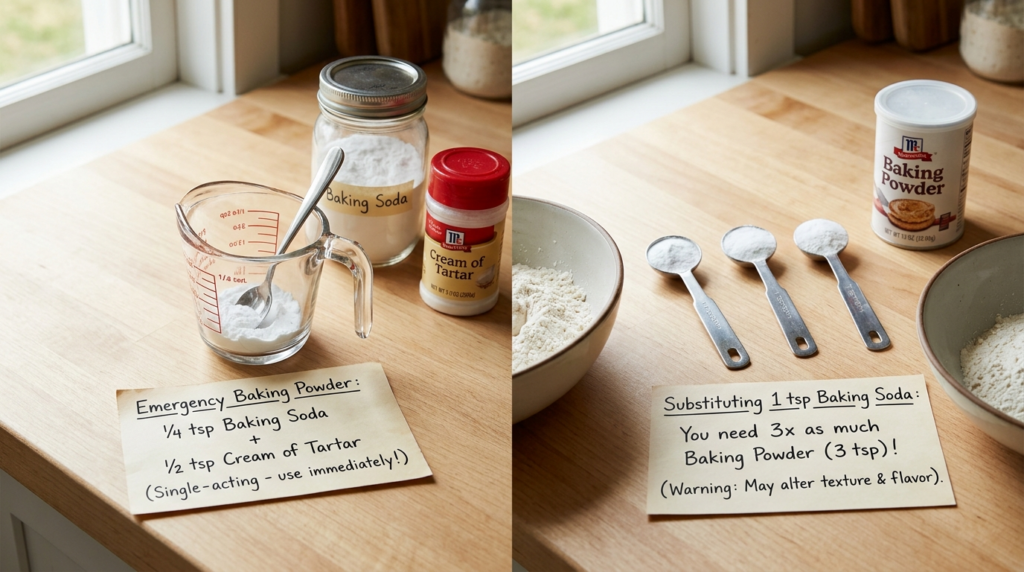
You can sort of pull it off, but it’s always a little wonky.
If you’re in a pinch and only have baking soda, you can fake a baking powder by mixing 1/4 tsp of soda with 1/2 tsp of cream of tartar. It’s not a perfect swap, but it’ll save your biscuits. Just remember it’s single-acting, so don’t let that batter sit around on the counter. Get it in the oven before the fizz dies out.
Going the other direction is trickier. If you only have baking powder and need soda, you’ll need about three times as much, and dumping that much powder into the recipe gives you a bitter, almost chalky aftertaste. Plus it won’t neutralize whatever acid is in there, so the whole flavor shifts. A recipe built around that soda-buttermilk combo will taste completely different with just extra baking powder, more tart, less balanced, kind of off in a way that’s hard to pinpoint but you definitely notice.
Honestly? They cost almost nothing. Buy both. Replace them twice a year. Keep them somewhere you can actually see them, not buried behind the cumin you bought in 2017.
The Cheat Sheet (For When You’re Already Mid-Recipe and Panicking)
| If your recipe has… | Use… | Why? |
|---|---|---|
| Buttermilk, yogurt, lemon juice, honey, natural cocoa, brown sugar | Baking soda | It needs that acid to wake up and start producing gas |
| Regular milk, butter, Dutch-process cocoa, no major acid source | Baking powder | It’s already got everything it needs inside, acid and base and buffer all in one |
| Buttermilk AND it needs to be really fluffy | Both | Soda handles the acid and browning, powder picks up extra lift |
| Nothing, you’re making puff pastry or angel food cake | Neither | Steam or whipped eggs do the heavy lifting here |
Other Ways Baked Goods Rise (It’s Not All Powder)
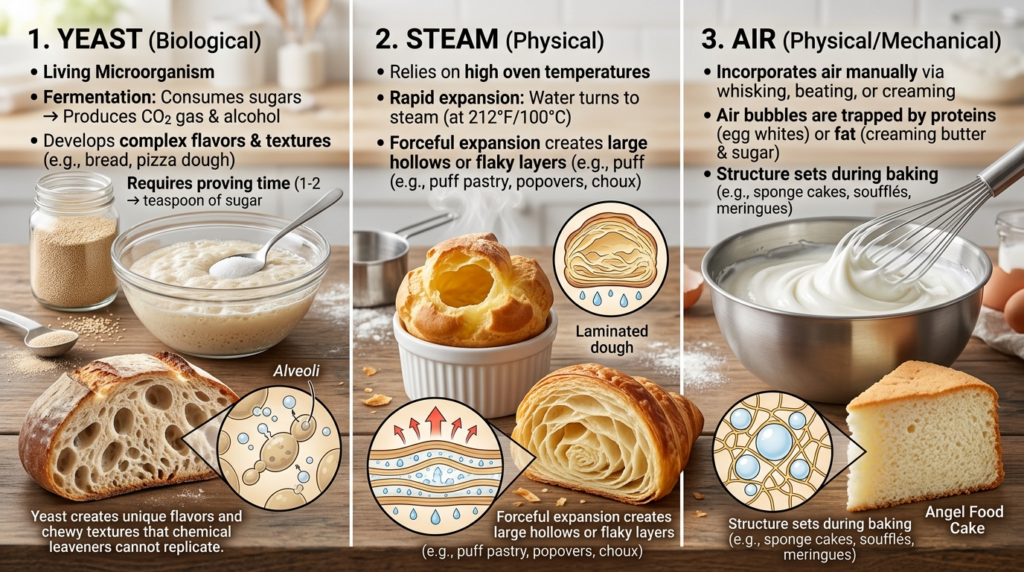
Chemical leavening is just one way baked goods get their rise, and sometimes knowing about the alternatives helps you understand why a certain recipe works the way it does.
Yeast is honestly kind of a diva. It’s a living organism that eats sugar and burps out CO₂, it hates the cold, and if the water you bloom it in is too hot it just straight up dies on you. The whole process is finicky and slow and takes way more patience than I usually have. But yeast produces flavors and textures that chemical leaveners can’t get anywhere close to. Bread is bread because of yeast. Don’t let anyone sell you a yeast-free “shortcut” bread and tell you it’s the same thing, because it is not.
Steam does more than most people give it credit for. Puff pastry, popovers, choux pastry (that’s your éclairs and cream puffs), all of those rely on steam. Water trapped in layers of dough turns to steam in a hot oven, expands, and physically forces layers apart. No chemicals, no yeast, just really hot air and moisture doing all the work.
And then there’s beaten eggs. Angel food cake is basically just whipped egg whites trapping thousands of tiny air bubbles inside a batter, and when the oven heats those pockets of air they expand and lift the whole thing into something tall and soft and almost wobbly. The wild part is that the pH of the egg whites and the way protein chains unfold and cross-link to form a rigid foam network around those air cells, that’s real molecular-level stuff, and people were pulling this off for centuries before anyone understood the chemistry. They just beat the eggs, poured, baked, and it worked. Nobody knew why.
The Mistakes That Keep Catching People

Measuring is a big one and I will not shut up about this. A heaping teaspoon versus a properly leveled one of baking soda is a massive difference when you’re working with something four times stronger than baking powder. Every extra bit counts here. This isn’t garlic where “a little more” is a vibe. Level your measuring spoons. Use the back of a knife. I mean it.
Overmixing is the other quiet disaster that nobody sees coming. The gas production started the instant your wet ingredients touched the dry ones, so every extra fold and stir is letting CO₂ escape into the air instead of staying trapped in your batter where you need it. Get it into the pan, get the pan into the oven. A few small lumps in your muffin batter? Leave them. That’s fine. The alternative is flat dense muffins because you spent too long trying to get things perfectly smooth.
Oh, and your oven is probably lying to you. Get a cheap thermometer, the kind that just hangs on the rack, and check what temperature you’re actually baking at. Every home oven I’ve tested runs at least 10 to 25 degrees off from what the dial says. If your oven is actually sitting at 325°F when you think you set it to 350°F, your cake might rise beautifully from the leavener doing its job and then collapse in the center because the structure didn’t set fast enough to hold all that gas. That sunken, gummy middle that makes it look like someone sat on your cake? That’s usually a temperature problem, not a recipe problem.
Even after all of this, after reading the food science books and doing my little side-by-side experiments and ruining enough baked goods to fill a dumpster, I still catch myself squinting at both containers every single time. Triple-checking the label before anything goes into the bowl. Some lessons only stick after enough disasters I guess, and maybe that’s just how it goes with baking. The pumpkin bread soap incident taught me more about leavening than any cookbook ever did, even if I’ll never fully live it down at Thanksgiving.